Sunday, June 25, 2006

Krrish invokes mixed reactions


Rakesh Roshan's Bollywood bonanza Krrish, his sequel to the super hit Koi Mil Gaya, starring his star son Hrithik Roshan, has been one of the most awaited movies of the year in Bollywood circles. For months, it has been promoted as India's first Superhero movie. The action sequences and special effects were tauted as the best Bollywood had ever seen. In fact, Roshan Sr said in an interview that "It (special effects) is not like Hollywood. It is Hollywood."

For me and many watchers, Krrish has been special also because it was extensively (60%) shot in Singapore. Singapore Tourism Board (STB) invited the Roshans to shoot the movie here and promote Singapore, hoping to repeat the Roshan effect on Indian tourists what they had seen in the case of New Zealand (Roshan's earlier film Kaho Na Pyaar Hai was shot in NZ and it had apparently increased the tourist influx to NZ many times over).

I haven't seen the film yet but the reviews have been kind of mixed.

Rajiv Masand says in IBNLive: "Yes, Krrish may actually be Bollywood's first stab at a superhero story, and the intention is commendable, but the effort leaves a lot to be desired." He adds: "My biggest complaint against Krrish is directed towards its screenplay: It stinks."

Sukanya Verma says in Rediff.com: "The production values are shoddy. SFX team of Marc Kolbe and Craig Mumma's shabby use of super imposed background is annoying and distracting. Cinematographer Santosh Thundiiayil could have opted for a darker, slick look. Instead, he lends Krrish an extra-bright and powdery appearance befitting a detergent commercial. Siu Tung Ching and Sham Kaushal's action gets no points for originality. Most of it is borrowed from Matrix flicks and is repetitive in nature. Surely there must be more to a superhero than surging from one pole to another. This gratification comes to you only in the tail end of the movie. Krrish neither has the sleek aura nor the deep-rooted ideology of superheroes. What it does have is a super spirited performance from Hrithik Roshan, which is likely to appeal to kids. And that's worth a three-star cheer."

Raja Sen in Rediff.com has another view to offer: "Do the Krrish writers succeed? Not really. While luxuriously taking up almost three full hours of screentime, they plod through an extremely derivative landscape. Ideas are borrowed from a bunch of movies -- the few people who have watched John Woo's Paycheck will feel some déjà vu -- and effect-shots from a million more, including The Matrix films, Spider-Man, and Crouching Tiger Hidden Dragon. And watch out for the distinct Batman hangover when he actually dons the mask. Krrish is mired by predictability. There are no big revelations, no sudden surprises. There's also no real character involvement, the viewer not actually caring enough about Krrish but just, like the protagonist himself, caught up in all his contrived coolth. However, the fact that it's exactly what the KMG fan expects is the reason the sequel will actually succeed. I'd bet on a sequel to Krrish."

That is a bit positive. More positive is Diganta Guha in The Hindustan Times: "Technically, Krrish is perhaps the best in Bollywood history, whether in terms of action, special effects, cinematography or sound. There's little for the actors to do but deliver their bit and let Roshan Sr take the credit for a brilliant package...The sleek action sequences by Hong Kong-based Tony Ching Siu Tung and Sham Kaushal set a new trend, and combined with the special effects by US-based Marc Kolbe and Craig Mumma, they are a treat to watch...Krrish is a breath of fresh air into the staid world of Bollywood, much like Sanjay Leela Bhansali's Black. Watch it for its own sake and feast your eyes on the spread Roshan Sr has laid out for you."

Wah! That is a wonderful review for Krrish. Roshans must be happy to read this but the site looks like the official promotional site of Krrish.

Surprisingly, none of the above mentioned reviews have mentioned, not even once, the breathtakingly beautiful scenes from Singapore and how well Roshan has exploited their picture postcard prettiness!

In fact, on the other side of the Singapore River, Singapore's Today film reviewer had some complaints against Roshan's portrayal of Singapore in "A prosaic portrayal: Krrish makes Singapore look uninteresting" (June 24, 2006):

"There is a good reason why so many Singaporean film-makers choose to set their films in Singapore's grittier spaces: There is little that is interesting about Singapore's snazzy side. And that is one of the problems with the blockbuster-wannabe Krrish — the first Bollywood film to be funded under the Singapore Tourism Board's $10-million Film in Singapore! Scheme."

"It doesn't make Singapore look terribly interesting."

In this sequel to the 2004 hit Koi Mil Gaya, Hrithik Roshan plays Krishna, a man with supernatural powers — his father was, wait for it, empowered by an alien called Jadoo — who falls in love with Priya (Priyanka Chopra) and follows her to Singapore. The problem is, Priya initially wants only to exploit his powers to score a hit show for the TV station where she works. So, Krishna and Priya go traipsing through Singapore's most prominent places in their courtship. Audiences get to see Shenton Way, Sentosa, Chinatown and Boat Quay filmed in the most prosaic ways. Buy a postcard and you'd get the same picture."

"Perhaps to add interest to banality of the setting, the film also portrays a seedier Singapore that doesn't really exist. As Krishna steps out of Changi Airport, two thugs on a motorcycle try to grab his belongings. And if the film is to be believed, Clifford Pier is a hangout for motorcycle thugs who speak bad English."

Whatever the criticism and irrespective of Krrish's aforementioned weaknesses, the film is going to increase the Indian tourist inflow to Singapore. After all, millions of Indians seeing the beautiful Singapore shots in the Krrish songs playing on their telly day and night won't be able to ignore the charm of the lion city.

Kitaab@APWN

There is this interesting news that I want to share with you. My website, Kitaab, has been featured in APWN (Asia Pacific Writers Network, an initiative of PEN Australia). Along with my editorial, writings by my friends Fakrul Alam, Deepika Shetty and Jai Arjun Singh have also been showcased. Take a peek here.

India vs China: Is the world really 'flat'?


Sorry for digressing from my pet topic of books and writers this week. I find the India vs Chian debate extremely engrossing as it concerns our own future. A good debate on the two rising economies has been going on for quite some time now.

Here is an interesting podcast, which in fact provides a radically different view on this topic (TiECON East 2006: Howard Anderson Keynote on India & China: Is the World Flat or “Spiky”?)

Venture capitalist Howard Anderson, in this podcast, predicts the position of India and China in the next 20 years.

Anderson says that India has a temporary advantage and it might lose the game if it does not move towards development of proprietory software and increase its manufacturing base (Amartya Sen said the same thing in a BBC interview a few days ago). India already employs about 10,000 foreign workers (from US, Europe as it is suffering from shortage of skilled workers!!) and the salaries of its workers are steadily increasing--damaging India's cost advantage (No wonder recently Apple decided to shut down its outsourcing lab there; Another company, a British power company, also recently closed down its call centre business in India).

China is developing its physical as well intellectual infrastructure at a great speed. It seems to be at a more advantageous position.

Saturday, June 24, 2006

America on the decline?


While the media is agog with stories of China and India rising and becoming great economic powers, America's decline as a technological innovator (and obliquely as a power) is also being discussed a lot these days. Recently, Newsweek ran a cover story on this theme titled, Can America Compete?

Writes international editor of Newsweek, Fareed Zakaria:

"Well, Americans have replaced Britons atop the world, and we are now worried that history is happening to us. History has arrived in the form of "Three Billion New Capitalists," as Clyde Prestowitz's recent book puts it, people from countries like China, India and the former Soviet Union, which all once scorned the global market economy but are now enthusiastic and increasingly sophisticated participants in it. They are poorer, hungrier and in some cases well trained, and will inevitably compete with Americans and America for a slice of the pie. A Goldman Sachs study concludes that by 2045, China will be the largest economy in the world, replacing the United States.

It is not just writers like Prestowitz who are sounding alarms. Jeffrey Immelt, CEO of GE, reflects on the growing competence and cost advantage of countries like China and even Mexico and says, "It's unclear how many manufacturers will choose to keep their businesses in the United States." Intel's Andy Grove is more blunt. "America ... [is going] down the tubes," he says, "and the worst part is nobody knows it. They're all in denial, patting themselves on the back, as the Titanic heads for the iceberg full speed ahead."

"Much of the concern centers on the erosion of science and technology in the U.S., particularly in education..."

In another relevant story, "The fast-fading luster of the American story" in IHT,
Nathan Gardels and Mike Medavoy conclude that America's soft power (its cultural exports) is on the wane. I have been thinking along these lines, and their ideas strike a chord with me--didn't somebody great minds think alike?

"This vast influence of American culture in the world is what Harvard professor Joseph Nye has called "soft power."

Now, however, we are witnessing a mounting resistance, particularly from Asia and the Muslim world, to the American media's libertarian and secular messages.

There is also resistance to the mere fact of America's overwhelming cultural dominance. Josef Joffe, the publisher-editor of the German weekly Die Zeit, has put it directly: "Between Vietnam and Iraq, America's cultural presence has expanded into ubiquity, and so has resentment of America. Soft power does not necessarily increase the world's love for America. It is still power, and it still makes enemies."

If, as Nye has said, politics in the information age is about whose story wins, America's story, which has won for so long, is losing its universal appeal.

Fewer and fewer are buying into the American narrative. Needless to say, that has big implications for America's storyteller - Hollywood - as well.

America's soft power is losing its luster for several reasons."

Now read on to know those reasons. The piece is thought-provoking.

Sunday, June 18, 2006

Minorities in Malaysia

I seldom write about politics here in my blog but this one is special. Fellow blogger, Sharanya Manivannan, sent me this link to her open letter to the Prime Minsiter of India. Sharanya forcefully talks about the despicable state of minority rights in Malaysia-- a real cause for concern. Reading her account makes me shudder at the dangers of radical Islam. Only yesterday I read the news that some Muslim clerics in Malaysia wanted to impose a ban on general Muslims from attending religious festivities of other religions. Thankfully moderate Malaysians have criticised such remarks. The same spirit and more needs to be shown for minority rights as well.

Read the open letter here.

A discussion on this topic is already on at Sepia Mutiny.

Fishwick does a la David Davidar and Dalrymple catches big fish

Michael Fishwick of Bloomsbury has done a la David Davidar. The publisher and cheque-writer has turned a fairly successful novelist. When I read about him here, I got reminded of David Davidar. Davidar was the CEO of Penguin Books India when he sent off his novel, The House of Blue Mangoes, to the most famous lit agent in London, of course under a different name. Fishwick did the same thing, and you know, he sent his ms to the same agent! Pure coincidence! Looks like Atundhati Roy's agent is the publisher's favourite too.

In the same interview, we get to know that Dalrymple has signed a huge deal with Bloomsbury that has caused some controversy in the publishing industry:

"But he stiffens at mention of the Dalrymple deal. "It wasn't wildly more than he was being paid at HarperCollins," he says sniffily. The reports ignored the small print, he adds. The £2m is for five books. "His last book sold 50,000 in hardback and will have sold 200,000 in paperback. All William's books sell 5,000 or 6,000 copies a year and have done since I first published him in 1987. So, in terms of where you are going to put your money, it is as safe a bet as you can think of."

Last Words

Harper Lee's has been a curious story. She did not publish anything after her first hugely successful novel, To kill a mocking bird.

Here is some light on her rather mysterious life:

Harper Lee's last major interview was given to Roy Newquist in March 1964, for his book 'Counterpoint'

"I never expected any sort of success with Mockingbird. I was hoping for a quick and merciful death at the hands of reviewers, but at the same time I hoped that maybe someone would like it enough to give me encouragement - public encouragement. I got rather a whole lot, and in some ways this was just about as frightening as the quick, merciful death I'd expected.

[My next book] goes ever so slowly. Many writers really don't like to write ...They loathe the process of sitting down trying to turn thoughts into reasonable sentences. I like to write - sometimes too much because when I get into work I don't want to leave it. I'll go for days and days without leaving the house. I'll go out long enough to get papers and pick up food and that's it.

This was my childhood: if I went to a film once a month it was pretty good.

We had to use our own devices in our play, for our entertainment. We didn't have much money. We didn't have toys, nothing was done for us, so we lived in our imagination most of the time. We were readers, and we would transfer everything we had seen on the printed page to the backyard in the form of drama.

It takes time and patience and effort to turn out a work of art, and few people seem willing to go all the way. I see a great deal of sloppiness and I deplore it. I think writers today are too easily pleased with their work. This is sad. There's no substitute for struggling, if a struggle is needed, to make an English sentence as beautiful as it should be.

I want to do the best I can with the talent God gave me. I would like to leave some record of... small-town middle-class southern life. All I want to be is the Jane Austen of south Alabama."

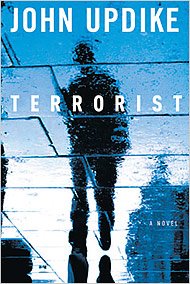
John Updike, Terrorism, and the Future of Books


These days terrorism is a hot topic for novelists. Both Yasmina Khadare and John Updike have come out with new novels that have terrorism as their central themes. While Yasmina Khadare's novel is titled "The Attack," Updike's is simply called "Terrorist."

Here's a review of Updike's novel by NYT's Michiko Kakutani:

"Unfortunately, the would-be terrorist in this novel turns out to be a completely unbelievable individual: more robot than human being and such a cliché that the reader cannot help suspecting that Mr. Updike found the idea of such a person so incomprehensible that he at some point abandoned any earnest attempt to depict his inner life and settled instead for giving us a static, one-dimensional stereotype.

"Terrorist" possesses none of the metaphysical depth of classic novelistic musings on revolutionaries like "The Secret Agent," "The Possessed" or "The Princess Casamassima," and none of the staccato, sociological brilliance of more recent fictional forays into this territory, like Don DeLillo's "Mao II."

However, this is not going to dampen my spirits. I look forward to reading these two novels.

Here is another link (podcast) to Updike's speech on the future of books. Quite interesting!

Thursday, June 01, 2006

In Lust We Trust?


Singaporean author Gerrie Lim is back with a bang, and his new book is lustier than his previous outputs: It is befittingly called, In Lust We Trust!

Lim was a scribe in the US in the yester years and used to cover the music industry and later on the porn industry there.

He got famous with his book on the escort business: "His 2004 book Invisible Trade, an expose on the upscale escorting industry, is in its third printing and has sold an impressive 20,000 copies."

Lim has used his porn industry experience (of covering it) to write his latest, what looks like, bestseller. In an interview with Today, he made some interesting points:

"I think that a lot of us are inherently voyeuristic, whether we like it or not. The people who deny it are obviously lying. The fact that someone bothers to watch a reality show where people make fools of themselves is voyeuristic, not to mention more exploitative than pornography."

"Of course, adult entertainment has been demonised and there is no way around that. It's like writing a book about professional wrestling and explaining it to people who think it's stupid. Well, stupid is the point. It's funny and not real because it's not sports but entertainment."

"It's the same with porn. Adult actress Nina Hartley gave me a great quote when I was researching this book: "You've got to remember that porn is basically live action sex cartoons."

If you can't hold it anymore and read the whole stuff, go here.

The Birth of a Jehadi


In its latest issue, New Yorker takes a look at the phenomenon of Muslim Jehadis, in the context of the last year's London bombings. The article quotes from a British investigation report and shows respect for its conclusions:

"The report concludes that there is no consistent profile that could be used to help identify who might be vulnerable to such radicalization, and yet the biographies do show in some detail how the making of an Al Qaeda-inspired suicide bomber is an idiosyncratic narrative of push and pull. Alienation from citizenship or family and a loss of faith in secular opportunity create a pool of potential volunteers; preachers, recruiters, and Al Qaeda leaders take it from there. The British parliament’s main intelligence-oversight committee, in a separate report, admits that Britain has failed to consider adequately how it might reduce the number of potential recruits: “We remain concerned that across the whole of the counter-terrorism community the development of the home-grown threat and the radicalisation of British citizens were not fully understood or applied to strategic thinking.”

In the same issue, Margaret Talbot profiles the famous Italian journalist Oriana Fallaci and her views on Islam.

In the piece, there is this interesting anecdote about Fallaci' meeting with Khomeni:

"Fallaci continued posing indignant questions about the treatment of women in the new Islamic state. Why, she asked, did Khomeini compel women to “hide themselves, all bundled up,” when they had proved their equal stature by helping to bring about the Islamic revolution? Khomeini replied that the women who “contributed to the revolution were, and are, women with the Islamic dress”; they weren’t women like Fallaci, who “go around all uncovered, dragging behind them a tail of men.” A few minutes later, Fallaci asked a more insolent question: “How do you swim in a chador?” Khomeini snapped, “Our customs are none of your business. If you do not like Islamic dress you are not obliged to wear it. Because Islamic dress is for good and proper young women.” Fallaci saw an opening, and charged in. “That’s very kind of you, Imam. And since you said so, I’m going to take off this stupid, medieval rag right now.” She yanked off her chador."

Fallaci has written a lot on Islam and the West in recent years. The profile further notes:

"She writes that Muslim immigration is turning Europe into “a colony of Islam,” an abject place that she calls “Eurabia,” which will soon “end up with minarets in place of the bell-towers, with the burka in place of the mini-skirt.” Fallaci argues that Islam has always had designs on Europe, invoking the siege of Constantinople in the seventh century, and the brutal incursions of the Ottoman Empire in the fourteenth and fifteenth centuries. She contends that contemporary immigration from Muslim countries to Europe amounts to the same thing—invasion—only this time with “children and boats” instead of “troops and cannons.”

Meanwhile, in the NYRB, Michael Massing somewhat rises to the defence of two American researchers who have done a controversial paper on the Israel Lobby in America.

"Not since Foreign Affairs magazine published Samuel Huntington's "The Clash of Civilizations?" in 1993 has an academic essay detonated with such force as "The Israel Lobby and US Foreign Policy," by professors John J. Mearsheimer of the University of Chicago and Stephen M. Walt of Harvard University's Kennedy School of Government. Published in the March 23, 2006, issue of the London Review of Books and posted as a "working paper" on the Kennedy School's Web site, the report has been debated in the coffeehouses of Cairo and in the editorial offices of Haaretz. It's been called "smelly" (Christopher Hitchens), "nutty" (Max Boot), "conspiratorial" (the Anti-Defamation League), "oddly amateurish" (the Forward), and "brave" (Philip Weiss in The Nation). It's prompted intense speculation over why The New York Times has given it so little attention and why The Atlantic Monthly, which originally commissioned the essay, rejected it."

Worth a read as it gives interesting insights into the working of political lobbies in the US.

Tuesday, May 30, 2006


Flamingoes in the Jurong Bird Park, Singapore.  Posted by Picasa

Has Londonstani sent the 'novel' for a Holiday this season?


Looks like, yes, if you read this Observer article. It says that the novel has lost its way!!

"This obsession with literary fashion comes at a price. Consider the sad story of Londonstani, a first novel by a talented young Asian writer named Gautam Malkani. Hype aside, this spirited coming-of-age story, narrated by Jas, a Hounslow schoolboy, in a mish-mash of patois, rap, text messaging and west London street-talk, is a promising debut. If it had been published, as its author once intended, as a teen novel, it might have found a secure place as a contemporary classroom cult.

Alas, everything about its short life has been a disaster. Once Fourth Estate, hungry to cash in on the White Teeth and Brick Lane market, had paid an advance in excess of of £300,000, the die was cast. Thereafter, Londonstani had to be 'the literary novel of the year'. Like a Fiat Uno entered for Formula 1, after a squeal of brakes and a loud bang, Londonstani was reduced to a stain of grease, and some scraps of rubber and tin, on the race track of the 2006 spring publishing season. In Borders or Waterstone's, Londonstani is already being airbrushed from history. The celebrity culture of which contemporary fiction has become an uneasy part has no use for failure, or the garret.

From almost every other point of view, and certainly for the consumer, this can occasionally seem like a golden age for books, in which it is impossible to overestimate the impact of the IT revolution. Certainly, the microchip and the internet have transformed booksellers, rejuvenated publishers, galvanised readers and given unpublished writers the kind of audience they had hitherto only dreamed of. Moreover, that truly modern phenomonenon, the blog, has enfranchised a new group of wannabes, creating the sensations of authorship (with none of the pain). Now almost everyone is a published writer. Literary life has become, perhaps for the first time, global, democratic and uninhibited. The bookshops are better equipped and the books they sell are better printed, better designed and better marketed than ever before. There's a huge audience, and apparently no shortage of money. It's an almost perfect environment for a new writer of talent.

But here, finally, is the irony. The greatest IT revolution since Gutenberg, a voracious marketplace, and the transformation of the novel's ambitions, has created a perfect cultural climate for someone 'to do the whole marvellous scene in one gigantic daring bold stroke' - and what do we find ? Despite an impressive showing by Booker in 2004 and 2005, elsewhere in the literary marketplace Fiction, the New Self-Expression, has become a cocky, well-paid and slick appendix to Hello! This is Lit. Lite, offering a short route to a quick buck, a blast of instant celebrity and a text devoid of consequence or meaning. Aptly, one of this season's hottest literary properties is a novel called Tourism, a case study in such packaging. When its author, Nirpal Singh Dhaliwal, published a savage review of Londonstani, perhaps only a Swift or a Shaw could do justice to the spectacle of apprentices wrestling in mud for the keys to the gates of Parnassus. It makes one strangely nostalgic for the bad old days of FR Leavis."

If the novel has really lost its way, I wonder where are all these wannabe novelists headed?

Laila Lalami in 'African Booker' Shortlist


Known as the 'African Booker', the $15,000 (£9,000) prize is awarded to a short story published in English by an African writer whose work reflects African sensibilities.

Laila Lalami, a Moroccan-born author, has been nominated for The Fanatic, a chapter from her novel Hope and Other Dangerous Pursuits. The book tells of four Moroccans who cross the straits of Gibraltar on a lifeboat in order to emigrate to Spain. According to Lalami, who now lives in Oregon and is the editor of the literary blog Moorishgirl.com, the story was inspired by an article she read in Le Monde in 2001 about 15 Moroccan immigrants who drowned while crossing the straits of Gibraltar in a fishing boat.

Read the full news here.

Wednesday, May 17, 2006

Beloved


In a survey by the New York Times, Toni Morrison has emerged as the beloved of the literati, of course, as an American writer. We can't even call it a prejudiced view or an colored opinion, right? But some do find a problem with this choice. Read more here.

In another notable development, did you think that authors are solitary creatures, and they don't need any company? If you did then think again. Here is a report by NYT:

"With authors fiercely battling for attention in a media-saturated world, an increasing number of writers — from first-time novelists like Ms. Dean to celebrities like Madeleine K. Albright, the former Secretary of State — are visiting people where they spend much of their time: at work." (Authors Meet Fans Far From Bookstores, at Company Events)

Londonstani


Ok, ok, I am late in talking about Gautam Malkani and Londonstani (almost rhymes). Actually, we were all so much caught up with the Kaavya episode that we completely forgot to celebrate this English author of Indian origin who has penned a novel titled Londonstani. For those who judge an author by the amount of advance he got, Malkani should impress. As the story goes, Malkani reportedly got an advance of, ahem, 300,000 Euros in Frankfurt Book Fair. Now, in dollar terms, that is more than what Kaavya got, right?

The novel is also making waves for its lingiuistic cleverness and the issues of identity and gender. Please see the links at Kitaab.

Malkani has been working with the Financial Times for the last seven years. He studied at Cambridge. Aren't you impressed enough to buy the book?

Sunday, May 07, 2006

Sex and the tale of two cities


Two sperate events but linked by sex, and Muslim sentiments are involved in both the cases. One takes place in Jakarta, in the capital of the Islamic state of Indonesia. Another in the Muslim dominated state of Jammu and Kashmir in India.

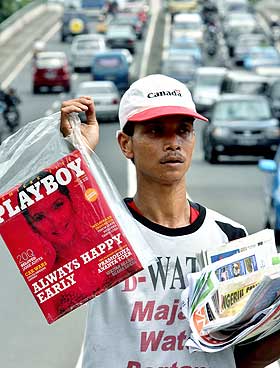
In April, according to reports, hardline Indonesian Muslims vandalised the office of Playboy magazine, protesting against its publication in that country, also the world's most populous Muslim nation. The protesters also destroyed several copies of the Indonesian Playboy, which unlike the U.S. original does not show any nudity. Despite being a much tamer version, the magazine sold out very quickly, thanks to controversy surrounding its publication.

Following strong protests, Playboy Indonesia has decided to delay its second edition for security reasons.

In Kashmir, angry Muslims have reacted over a sex scandal allegedly involving some former ministers. They destroyed the house of Sabina, the alleged kingpin of the sex scandal, and set her belongings on fire.

The report says that the sex racket was exposed after police seized a CD containing pornographic clips of a young girl, Sabina, who said that several politicians and police officials forced her into prostitution.

While the Indonesian magazine is on hold amid questions of freedom of expression and Islamic laws, it remains to be seen if the exploitative Kashmiri politicians and officers are going to be identified and prosecuted.

Bollywood lessons


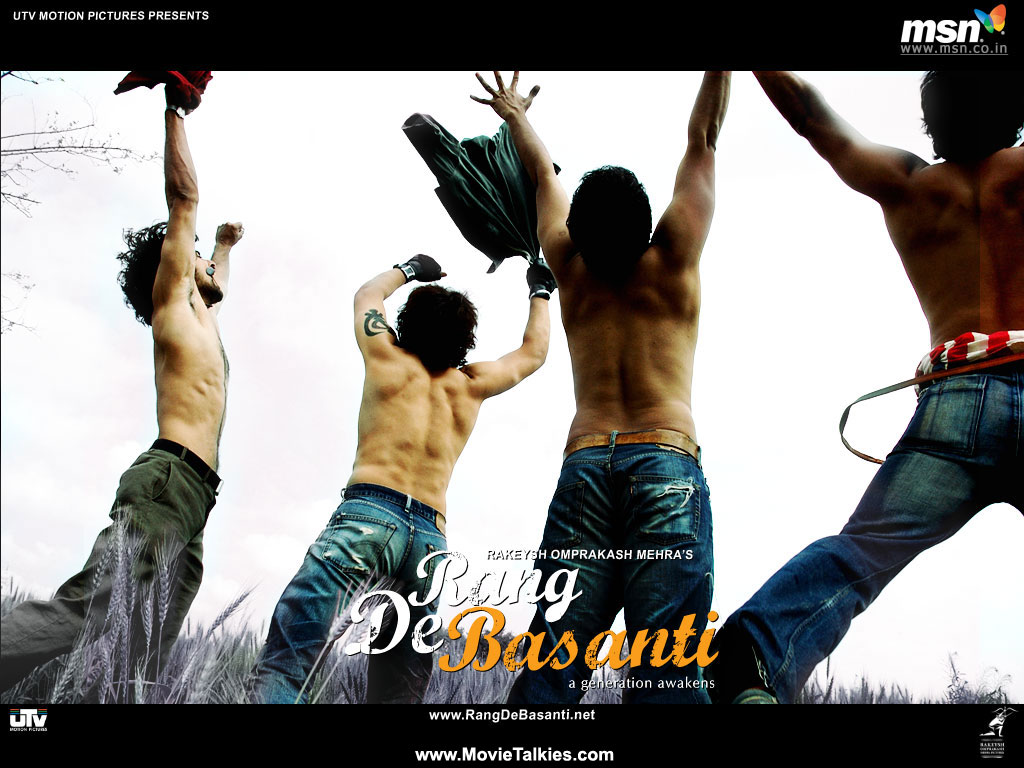
Bollywood is making waves these days--both at home and abroad. As 'Sholay' enters school textbooks, school teachers in Delhi are being exposed to more films from the Mumbai film industry. As per a report in The Hindustan Times, the Delhi government is holding special screenings of Munna Bhai MBBS and Rang De Basanti as a part of its teachers' training programme.

It is definitely an interesting way of training teachers. And both the films are remarkable in their own ways.

A few years ago, we too made a documentary film (India's economic transition through Bollywood) that showed India's economic milestones through clips of scenes gleaned from hundreds of films. India's two maverick economists, Amir Ullah Khan and Bibek Debroy, had piloted the project. The film was shown in management schools across India.

Recently, Google has also funded a non-profit venture in India that uses Bollywood film songs as a literacy tool. Great going Bollywood!

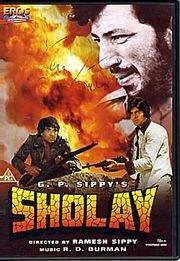
Sholay in school text books


Ramesh Sippy's Sholay (1975) is India's one of the most loved and talked about films ever. It has been loved by generations of Indians, and it enjoys the distinction of being India's first biryani western. On the Indian box office it has been one of the top ten grossers of all time. In short, it has many firsts and records to its credit.

The latest distinction achieved by Sholay is academic. It is the first Indian film to be included in a school text book:

"For the first time in the history of Indian academia, an entire chapter in a school textbook will be devoted to a mainstream Bollywood blockbuster.

Ramesh Sippy’s multi-starrer Sholay has been added to the Broadway course workbook No 5 for Class V students of CBSE.

"Published by Oxford University Press, the inclusion of Sholay is a continuation to the chapter on films and film-making in the Broadway book, which is designed to help students communicate effectively and accurately in English.

"The National Curriculum Framework 2005 postulates that the multi-lingual character of our society be treated as a resource and school teaching should focus on what the child understands. Since films are an integral part of our culture and Sholay is one of the most influential films, it has been included in the course, said sources.

"The text on films and filmmaking in the course book and Sholay in the workbook is a representation of Indian drama in the life of a child. The choice of Sholay was made because it is a different film in many ways. Besides,we wanted children to be aware of the prominence attached to the Indian film industry," said an insider." (The Times of India, April 29)

More on Sholay is here.

Saturday, April 29, 2006

Kaavya's Opalgate


At first, I was reluctant to blog about this issue, but ever since the plagiarism news got broken in The Harvard Crimson, the floodgates of comments and blogs opened, and Harvard Sophomore Kaavya Viswanathan has been pilloried uncessantly.

I am not writing this post to defend Kaavya here. Nor do I support any act of plagiarism (though copycat Bollywood does it all the time but no one touches its whiskers). Not 14 as initially reported but about 39 counts of plagiarism were found in Kaavya's novel, How Opel Mehta Got Kissed, Got Wild and Got A Life. Interesttingly, the novel was not selling like hot cakes. It was not on the NYT bestseller list. At Amazon, it was at some 300+ rank. Once the controversy broke out, Kaavya has hit the international headlines. She has become one of the top ten searches at Technorati.

Is this a story of getting all the glory (the USD 500,000 advance, a movie deal, international coverage) for an eighteen year old and then giving everything away, nosediving into the abyss of disrepute? Or there is something more to it than what meets the eye?

I guess people should pay attention to a NYT report that addresses this angle:

"Nobody associated with the plagiarism accusations is pointing fingers at Alloy, a behind-the-scenes creator of some of the hottest books in young-adult publishing. Ms. Viswanathan says that she alone is responsible for borrowing portions of two novels by Megan McCafferty, "Sloppy Firsts" and "Second Helpings." But at the very least, the incident opens a window onto a powerful company with lucrative, if tangled, relationships within the publishing industry that might take fans of series like "The It Girl" by surprise."(The NYT)

Look at these important facts and decide for yourself:

1. On the copyright page of Kaavya's novel — and the contracts — there's an additional name: Alloy Entertainment

2. The relationships between Alloy and the publishers are so intertwined that the same editor, Claudia Gabel, is thanked on the acknowledgments pages of both Ms. McCafferty's books and Ms. Viswanathan's "How Opal Mehta Got Kissed, Got Wild, and Got a Life."

3. Alloy owns or shares the copyright with the authors and then divides the advances and any royalties with them.

4. The publishing contract Little, Brown signed is actually with Alloy, which holds the copyright to "Opal" together with Ms. Viswanathan. Neither Little, Brown nor Alloy would comment on how much of the advance or the royalties — standard contracts give 15 percent of the cover price to the author — Ms. Viswanathan is to collect.

5. After the breaking out of the controversy, both the books have gone up in the Amazon.com rankings. It means sales of these two books multiplied.

6. Ms. McCafferty, from whose novels Kaavya has stolen the phrases, has clearly said that she was not pressing any legal charges against the erring author.

7. Kaavya has gone on leave from her school. In a few week's time, the story will be forgotten, and Ms Kaavya will go on with her normal life.

Based on the above, please make up your own mind. And let me know if you have anything to say on this.

Wednesday, April 26, 2006


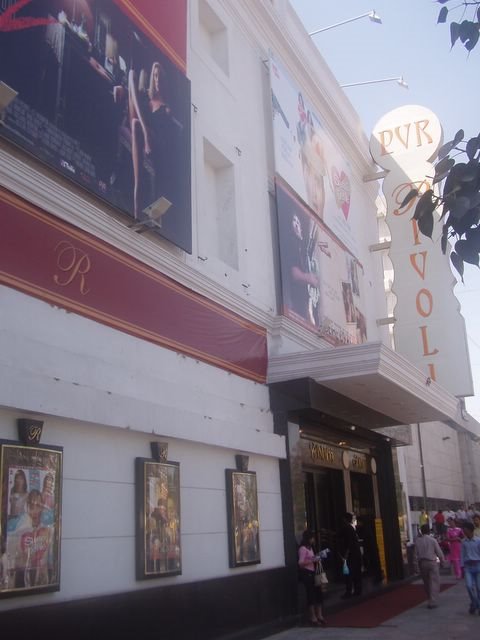
Rivoli Theatre in Connaught Place Delhi--the once seedy cinema hall has got a facelift under the PVR Cinemas, the new owners. You can see the poster of Basic Instinct 2 on the wall.  Posted by Picasa