Showing posts with label Zafar Anjum. Show all posts

Tuesday, December 09, 2014

‘Startup Capitals’ now available for pre-order!

Startup Capitals : Discovering the Global Hotspots of Innovation (English)
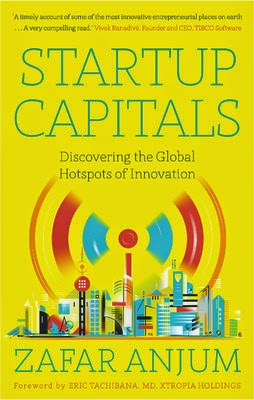


Product Details

Hardcover: 320 pages
Publisher: Random House India (31 December 2014)
Language: English
ISBN-10: 8184005946
ISBN-13: 978-8184005943
Product Dimensions: 22.4 x 14 cm

As the Internet has matured in technology and reach, we have seen an explosion in tech startups all over the world. Not only are some of these startups changing the world and how we live in it, they are also proving to be the engines of job creation – an aspect that will be critical in the future. To support these startups, new ecosystems are popping up all over the globe to help grow these companies, aided by governments, successful entrepreneurs and venture capitalists.

In Startup Capitals, Zafar Anjum brings you a ringside view from the worlds top ten startup cities of the world. Well-researched and highly insightful, this book lays bare the engines of innovation and the lessons that can be learnt from these burgeoning startup capitals.

Advance praise


  • "As we enter a new phase in human history – a phrase Ive referred to as Civilization 3.0-creativity and entrepreneurial spirit are achieving new milestones for humanity. How and where this creativity is flourishing today is the subject of Anjums book. It is a timely account of some of the most innovative entrepreneurial places on earth and should prove to be a very compelling read." – Vivek Ranadive, Founder and CEO, TIBCO Software, Inc. Owner, Sacramento Kings
  • "Startup Capitals takes us on an enthralling and stimulating tour of some of the most innovative cities on the globe. It is a timely and illuminating account of people and places that are shaping the human future." – Virender Aggarwal, CEO, Ramco Systems
  • "Creativity and invention do not occur in isolation. Environment and community fuel it. Mr. Anjum gives us a journey through those landscapes where the future is being created and inspires us to join those cities of innovation that define our time." – Matthew Putman PhD, CEO, Nanotronics Imaging, New York
  • "Silicon Valley is more than the sum of its parts. And as the world looks at the ‘sum’, this new book zooms in on the parts-the history, events, people and unique occurrences that add up to make the Valley what it is. As a tech strategist and business partner with more than 30 years of experience with Silicon Valley, I value the insight and specific recommendations Zafar Anjum has gathered in this important book." – Barbara Bates, Founder and CEO, Eastwick, Silicon Valley
  • "Many of the world want to emulate Silicon Valley, yet few have brought context to the incredible story thats taken shape here. Looking deeply at the Valleys history and how our unique ecosystem took shape, Zafar Anjum offers new perspectives that global innovators can use as they envision the communities-and the companies-that build economic success." – Ellen Petry Leanse, Tech Pioneer and Advisor, San Francisco
  • "Zafar does a brilliant job identifying the key factors that make a city a startup city. – Daniel T. Cohen, Cybersecurity Professional and Strategist at RSA, The Security Division of EMC, Israel
  • Where will be the next centre of innovation? What are the ingredients for a successful startup ecosystem? These are significant questions for which the jury is still out. Through this book, Zafar Anjum offers insights into the intriguing and exciting world of startups that are shaping our future." – Manish Goel, co-founder and CEO, TrustSphere, New York
  • "Over the years, Zafar has created a highly respected body of work in journalism. He tackles his subject matter with the tenacity and thoroughness of a good investigative reporter. His previous books have not only been great pieces of journalistic work but also, most importantly, good reads. Startup Capitals promises to be an informative and engrossing piece of work which will add to the understanding of why some cities are more successful than others in nurturing innovation and a risk-taking culture." – Amit Roy Choudhury, Technology Editor, The Business Times (Singapore)

About the Author

Zafar Anjum is a Singapore-based journalist, writer and filmmaker. He currently works as the Asia Online Editor of Computerworld Singapore, CIO Asia and MIS Asia. His most recent works include Iqbal: The Life of a Poet, Philosopher and Politician (2014), The Resurgence of Satyam (2012) and The Singapore Decalogue – Episodes in the Life of a Foreign Talent (2012). He edits a literary website, Kitaab.org.

Pre-order the book at Amazon and Flipkart now.

Wednesday, December 26, 2012

Why I wrote The Singapore Decalogue?


My first collection of short stories, The Singapore Decalogue: Episodes in the Life of a Foreign Talent (Red Wheelbarrow Books, 2012) was released in November this year at the Singapore Writers Festival. The book was supported by the National Arts Council Singapore under the Arts Creation Fund grant.
In this collection of short stories, I have tried to create vignettes of life in Singapore. This is my tribute to this city state, which has built its social capital with great wisdom, civic sense, and quotidian practicality.
Like many modern metros, the Lion City is compact, with people of various ethnicity and nationalities living side by side. Though they live mostly secluded, private lives, there are times when their paths cross. This civic commingling of people can be harmonious or chaotic, depending on the circumstances.
In these stories, I have tried to portray the hopes and frustrations of a few interconnected characters (that was truer for the earlier draft when the characters were varied). The bustling metropolis attracts all kinds of people who want to make a life here. What happens to their dreams? What kind of struggles do they go through? Do they feel alienated? What do they love about the city? And so on.
Through the panoply of characters, mainly built around a main character, Asif Basheer, an aspiring poet from India, I have woven together a web of stories that throw light on various contemporary themes. The initial aspiration, following in the footsteps of Tolstoy and the Polish filmmaker Krzysztof Kieslowski (especially his film cycle, The Decalogue), was to explore themes based on the Ten Commandments, but I finally transformed the idea. I was anxious, even afraid, that the stories might come across as too moralistic or formulaic if I went down that route. Nevertheless, my moral concerns about making choices in life still shaped and informed the stories in The Singapore Decalogue.
As I have said elsewhere, more than a writer I am an inspired reader. In terms of actual inspiration behind the stories in this collection, there were many influences—both from life that I have seen from close quarters and from books that I have read over the years. So, in these stories, besides expressing my appreciation of the city and its people, I have also tried to pay my debt to many of my favourite writers and their works that I have benefitted from. The first story, that introduces the main character, is my homage to Fyodor Dostoevsky. In fact, the story begins in the same way as the master’s novel, Crime and Punishment. His protagonist, Raskolnikov, a conflicted and aspiring intellectual, finds a modern day reflection in my main character, Asif Basheer. As the stories unfold, we become privy to Asif’s trials and tribulations and see life in Singapore through his life’s prism. We meet characters who interact with Asif or come into his life. In the earlier version, Asif’s story culminates in a bizarre incident in Boat Quay—Singapore’s commercial heart but that has changed in the final version.
In the original version, the last story summed up the aspects of Asif’s life in epistolary form and it was meant to be my tribute to Gustave Flaubert who wrote some of the most beautiful and passionate letters that I have ever read. In my view, this completed an arch—the first story and the last—as both Dostoevsky and Flaubert were contemporaries in 19th century Europe, and died one year apart (1880 and 1881 respectively). This was how I had tried to connect the past with the present. No matter how times change, people and their hopes and sufferings remain the same. Besides these two great writers, there are stories in the collection that are inspired by the styles of my other favourite writers—James Joyce, Ernest Hemingway and Hanif Kureishi. Initially, my model was Joyce’s Dubliners in which he tried a naturalistic depiction of the Irish middle class life in and around Dublin in the early years of the 20th century. A lot changed from the initial idea but that was what I had in my first draft.
A note of explanation here: by dropping big names (Joyce, Hemingway, et al.) I don’t claim any greatness for myself (how could I?). That would be preposterous and arrogant of me (some have already charged me of being a snob because I don’t like most of the books that are being published today, especially fiction—so I don’t want to aggravate matters here). I am doing that because I want to acknowledge my debt and put on record that I drew inspiration from their works, and that I feel a sense of kinship with them (as many reader would feel towards their favorite writers).
The first draft of The Singapore Decalogue was ready in 2011 and as I started working on the book with my publisher and my editor, the contours of the collection began to change. The publishers had liked the opening story, Crime and Punishment, so much that they wanted to have Asif Basheer, the main protagonist, as the lead in each story. That was not my plan.  This meant that I had to drop almost half the stories from the collection and write new ones. I needed some time to do that. By that time, I was also working on my non-fiction book, The Resurgence of Satyam, and had started work on a screenplay. So, there was a hiatus between the first batch of stories that I wrote in 2010-2011 and the later stories that went into the collection. They were written after July 2012.
I still like some of the stories that were dropped from the first draft. Who knows? They might go into The Singapore Decalogue 2.
Copies of The Singapore Decalogue are available at Kinokuniya, Singapore for purchasing and at all branches of National Library Singapore (NLB) for borrowing. 

Wednesday, October 10, 2012

The Resurgence of Satyam: The book is here


Those who have been in touch with me know that I have been working on several projects for the last two, three years--a novel, a collection of short stories, a book of non-fiction, and a screenplay. Besides holding on to a day job, these projects were one big reason why I wasn't blogging that frequently. However, I have been actively micro-blogging on Twitter and Facebook and those who follow me in those spaces would vouch for it.

I published my first book in 2000 and did a volume of poetry (translation) in 2001, and after that there has been a long period of silence in terms of books. But actually, this more than a decade long absence is well-accounted for: first I moved from Delhi to Singapore, and then I did a lot of journalism and blogging, and wrote and published quite a respectable number of short stories in some respectable places. And I read as much as I could. Meanwhile, I struggled with a novel and did several drafts.

Now, one by one, hopefully, all these projects will come to life.

This morning, I came to office and I was drowsy under the influence of a cough mixture that the doctor had given me yesterday. I was fixing myself a cup of green tea when the courier guy arrived in the office lobby. "Zafar, there's a courier for you," my colleague Madura said.

I came to the front office and received the big box from Random House. I immediately knew what it contained: the author copies of my non-fiction book, The Resurgence of Satyam: The Global IT Giant. You can read more about the book here. If you want to read excerpts of the book, go here.

The book's journey had started in 2011 and it was written in the latter half of that year and the first half 2012. Writing it entailed a lot of research. I read, I traveled, and I met and interviewed a lot of people. Almost a year of intense work. Now, the book is out and it will soon reach the bookstores.

"So, finally, the book is here," I told myself, holding a copy in my hand. "We are delighted at the way it looks," my editor wrote in an accompanying note. Yes, it does, it has turned out well. I hope it reads well too, and dear friends, only you can tell me if I have succeeded in that.

I would like to hear from you soon.

Buy your copy and let me know what you think of it.

Warmest,

Zafar

Monday, January 31, 2011

Telling a Singapore Story

In its November-December 2010 newsletter, INSTEP, the National Arts Council (Singapore) has profiled two of the 11 literary artists (whose projects have been) selected for support under the 2010 Arts Creation Fund scheme (Literary Arts). The details about the selected artists can be found here (click on the annex toward the end of the press release).

Other successful writers include Michele Koh (Baggage), Rosemary Charlotte (Dat Ting Dare), Ling Yang (Family Portrait), Alfian Bin Sa'at (Malay Sketches), Jeremy Jeyam Samuel (Macdonald House), Yeo Wei Wei (In the South), Lee Yew Leong (On a scale of 1 to Infinity), Jason Wee (By Thirds and Halves) and M. Balakrishnan (Bird Sanctum).

One of the two writers profiled in the newsletter is Lee Ju-Lyn, a 28 year old human resource executive who is working on a novella centered on the character Millie. Ju-Lyn's work is tentatively titled, Millie and Her Dreams.

The second profile is mine where I talk about my project, Singapore Decalogue, and what the ACF grant means to me.

Read the write-up on Ju-Lyn and me here.

Saturday, January 09, 2010

The Lone Fighter

One of my short stories (The Lone Fighter) has appeared in the Dhaka-based The Daily Star's Weekend magazine:

"That's all trash, brother. Why are you wasting your time?” a voice accosted me, catching me midway between a sentence and the next on a page in The Rachel Papers.

On that evening I was at Kinokuniya. After browsing through a number of classics, I was standing in front of a shelf full of contemporary works. Amid scores of novels dealing with adult themes by writers I didn't recognize, two titles, one by Martin Amis and another by Ian MacEwan, grabbed my attention. I was especially interested in Amis's work. It was his first novel, The Rachel Papers that I was looking at. It was at that point of time that Asato's voice reached my ears: “That's all trash, brother. Why are you wasting your time?”

The intrusive voice offended me. I turned back and saw this little bald man in dishevelled clothes standing right behind me. He had a bespectacled oriental face resting on a slender neck. I couldn't remember seeing him before.

In a hectoring tone, he started a volley of unsolicited commentary, “and the shelf next to this, and even the one next to it…it is all trash, brother” the stranger said, pointing his small fingers to the neighbouring shelves in the bookstore.

What rubbish, I thought. I had just seen a Dr. Zhivago on one of those shelves.

“This is not literature brother. This is all sex and trash,” he remarked.

I felt my raised heckles calming down. In a moment, the man's sincerity had me enthralled.


Read the full text here.

Wednesday, December 16, 2009

Interview with novelist Mohammed Hanif

Mohammed Hanif was born in Okara, Pakistan. After leaving the Pakistan Air Force Academy to pursue a career in journalism, he worked for Newsline, India Today, and The Washington Post. While heading the BBC Urdu Service in London, he penned his first novel, A Case of Exploding Mangoes. Here, he is in conversation with Zafar Anjum, co-editor of Writers Connect, in Singapore. The author was in Singapore to attend the Singapore Writers Festival this year.

Sunday, July 12, 2009

Anjum on e-books and publishing

My interview @ chillibreeze. I discuss the future of publishing in Asia

Excerpts:

The popularity of e-books will increase with the adoption of smart phones or such devices. Today I am reading electronic versions of books that are not easily available or are out of print. Tomorrow I might be reading more contemporary books in their electronic form because they might be cheaper and more convenient to read (or consume in audio form) that way.

In Singapore, I already see young people reading books (or longer texts) on their phones on the bus. Singapore National Library has a website where people can submit their short stories or download a short story to be read on their PDAs or phones. In Japan, people are reading novels on their cell phones. Elsewhere, people are tweeting their novels. In the next two generations, e-books might become the mainstream reality.

More