Thursday, August 03, 2006

Lady in the water


Terrible reviews have greeted M Night Shyamalan's latest outing, Lady in the Water. The local reviewer had problem with the premise of the story itself--a tale of narfs and scrunts--supposed to be an Eastern bedtime story that no one has heard in the East.

Shyamalan is a fantastic director, and I like some of his trademark story telling techniques, his camera placements, lighting, and cinematography techniques. And you have to agree that despite his penchant for casting himself in his own films, in roles however minor, he has given us some of the most original movies of our times. Though in his current film, he makes a character mock at the idea of orginiality in films. The character, a film and art critic, the only human character in the entire film that gets killed, says at one point: There is no orgininality left in the movies. Quite true. And Shyamalan's successful portrayal (in the act of the critic's killing) of what he thinks of the critics.

To begin with, I never liked the poster of this Shayamalan film: it is mysterous but in a scary way. I think the poster communicates a different kind of message to the potential viewers, and I will not be surprised if this film does not do particularly well at the box office.

The film opens with a message: We must return to good, we must stop being bad, and the mythic characters like the narfs are here to help us.

There are two things that make this film different, at least from the point of view of Shyamalan's earlier films. The first is casting Paul Giamatti who is brilliant in the film. In fact, one reason I went to see this film was Giamatti. I liked this actor in Sideways and since then I have been wanting to see more of him.

The second is Shyamalan's use of cinematographer Chris Doyle, who has a vast experience of working with Hong Kong auteur Wang Kar Wai. There are many departures from his trademark shots taking and the visual narrative style. The result is an interesting change. The pace of the film, the shots, the camera movements are in alliance with the theme of the film which is basically a retelling of a simple story that we are supposed to believe in.

Initially, Shyamalan was supposed to do this film for Disney but reportedly Disney did not see any potential in this film. Shyamalan hitched his wagon to Warner Brothers. Critics have already panned this film, and some have even declared Shayamalan a spent force. I think Shyamalan's time is not up yet and he will keep surprising us.

Tuesday, August 01, 2006

How much do you love me


There are very few actresses who are a pleasure to watch. Italian actress Monica Bellucci is surely one of them.

I went to see this french film, How much do you love me, just because of her. I was not disappointed at all. The director has made a clever use of her beauty and persona.

The story of the film is simple, or I would like to call it simplistic. A jerk goes over to Monica who is a prostitute and tells her that he has won a million dollar lottery. Without verifying his claim, Monica agrees to stay with him for a huge monthly salary. The guy, weak of heart, swoons with happiness, and his doctor friend, who himself leads a patehtic life, dies of heart attack when he sees a naked Monica. There are some nice comic sequences, the best is an argument on orgasm with the protagonist's neighbour.

And the most erotic scene in the film is not when Monica is shown naked or semi-naked. It is when she takes off her overcoat for the first time in front of the hero. The way she has done that scene, the erotic tension of that screen moment, is unforgettable.

Sunday, July 23, 2006

Isn’t happiness a little overrated?

Every time there is a survey of unquantifiable traits like happiness and courtesy, we react as if someone has pricked a needle in our inflated ego of self-imagined humility or cast a stone at our glasshouse of laugh riots.

31 out of 34 in courtesy? 132 in Happiness Planet Index, the worst in the region? Could the rankings get anymore dismal?

The happiness rankings tell us that Singapore is a melancholy state and its black mood is shared by millions of its citizens.

In reaction, some sigh with despondency. Some froth with rage. Others try to debate and indulge in some introspection. Why are we what we are?

The question is: Is perception more real than reality? Do these rankings really mean anything? How does one ensure that a few citizen’s bad mood don’t take down a country’s ranking by several points?

Let us go beyond Singapore and look at a particular example.

As per the courtesy survey, Mumbai was ranked as the rudest city on earth. Mumbaikers were obviously not mighty pleased with their ranking but they grinned and bore it. And when the opportunity arose, recently during the July 11 train bomb blasts, they showed their true mettle. They went beyond courtesy. They demonstrated that humanity was alive and kicking even in the rudest city on earth.

I think, of all things, humanity matters most. It is the kernel of our civilization.

Singaporeans have also demonstrated their humane side during the tsunami two years ago. They broke all previous donation records in a short period of time. Every year they donate millions of charity dollars. That is quite commendable.

Coming back to the main issue, I frankly feel that happiness is overrated. All this song and dance about happiness is overblown.

Happiness is so mercurial. We don’t really know much about this animal.

A child beggar cries and begs at a Mumbai traffic light. He succeeds in creating enough pathos in you. You give him a coin and move on. You feel happy because you think you helped someone. You don’t look back. If you did you would know you’d been conned. The crying kid would be smiling on your back.

But, is his smile genuine? Is he genuinely happy? Who knows? And if you knew that he’d conned you with his theatrics, wouldn’t your happiness evaporate then and there?

Happiness is like God. If you went out in search of happiness, you won’t find it anywhere. Like God, it lives within your heart and you will have to find it there.

I will give you another example. When I was coming to Singapore, I was warned. Singaporeans don’t smile. They don’t laugh.

When I came here, I saw something else. One has to be simply blind not to see Singaporeans smile and laugh. Some Singaporeans prefer to maintain a reserved attitude though. In no city you will find all the citizens smiling and laughing all of the time. Singapore is no different.

But why are Singaporeans perceived to be so unhappy? I think there is a reason.
In just four decades, Singapore has leapfrogged from bullock carts to A380. It is no laughing achievement. This country’s success is a testimony of its people’s determination because it is people who make countries.

More precisely, it is hardworking citizens with aims, ambitions and goals who make successful countries.

Singapore is not built on tradition but on drive. Singaporeans display a sense of purpose in their day-to-day lives and so they seem to be humourless in public.

But the truth as we know is this: Happiness is a state of mind. Most often, we don’t know if we are happy but we sure know if were happy at some point of time. Right now is the time to act, to move on, and to live and let live. Happiness will follow.

On books

We know that bad news is good news. But is it true for books as well? Now an author has made the claim that bad reviews could actually augur good business. Read it all here.

Technology is really changing the way books are being produced and consumed (yes, consumed and not read, not necessarily). Now you can create your own book online with all the pictures, and you yourself are the author and designer of the book. Interested? It's all here.

Thursday, July 20, 2006

Virgin’s Devi triumphant in the US


Indian filmmaker Shekhar Kapur’s comic book warrior Devi has a lot riding on her slender, but strong shoulders. Not only does Devi have to combat a fallen dark God called Bala; she is now the champion for Indian superheroes drawn from ancient mythology in lands that grew up on Superman and Catwoman.

In January this year, Virgin Atlantic boss Richard Branson teamed up with US-based motivational guru Deepak Chopra and Shekhar Kapur to create an Indian equivalent of stylised, futuristic Japanese-style cartoon books known as manga. The three-way joint venture is also aimed at producing cartoon films. Virgin just rolled out its first comic book — Devi created by Kapur and artist Mukesh Singh — in stores across the US.

Devi has sold over 10,000 copies in the United States in the first two weeks since publication and the Virgin Comics reincarnation of the Indian Goddess is heading for cult status.


Read the full text here.

Why bother with Patrick White?

Sometime ago, a British newspaper did it with one of Naipaul's books. Now, an Australian newspaper has pulled the trick off with an Australian Nobel prize winning novelist, Patrick White. The results are similar. Intrigued? Read on:

HE is the nation's most lauded novelist, our only Nobel prize-winning writer, twice a winner of the Miles Franklin award and three times the Australian Literature Society's Gold Medallist. Yet without his name on the cover, Patrick White's work is apparently of little value to Australia's publishing industry.
Inquirer submitted, under a pseudonym, chapter three of White's The Eye of the Storm to 12 publishers and agents. This novel clinched his Nobel Prize in Literature in 1973, with the judges describing it as one of his most accomplished works.

Not one reader recognised its literary genius, and 10 wrote polite and vaguely encouraging rejection letters. The highest praise was "clever". A low point was a referral to a "how to" book on writing fiction.

Pan Macmillan referred the author to writers' workshops; Mark Latham's agent, Mary Cunnane, recommended the author improve by reading Penguin Books' The Art of Writing, for hints on character and form. Text Publishing, which prides itself on finding and publishing Australian literature, sent back a form rejection letter and HarperCollins flicked it back unread.

For the experiment, the title of the manuscript was tweaked to become The Eye of the Cyclone, and an anagram was used for the author's name, Wraith Picket. And the age chosen for the 33-year-old father of one was the number of years that have passed since White wrote the novel.

Cunnane is a respected agent of 30 years' experience. She wrote: "Alas, the sample chapter, while (written) with energy and feeling, does not give evidence that the work is yet of a publishable quality.

"I suggest you get a copy of David Lodge's The Art of Fiction (Penguin) and absorb its lessons about exposition, dialogue, point of view, voice and characterisation."

Nicholas Hudson, of Hudson Publishing, found the work perplexing. "What I read left me puzzled. I found it hard to get involved with the characters, so it was not character-driven, nor in the ideas, so it was not idea-driven. It seemed like a plot-driven novel whose plot got lost through an aspiration to be a literary novel. It was very clever, but I was not compelled to read on," he wrote.


Read the full article here.

Krrish and the Spirit of Asian Cinema


July has been a gloomy month for Mumbai. First, the torrential rains almost brought life in Mumbai to a grinding halt. Then came the July 11 train bomb blasts, claiming over 200 innocent lives.

But amazingly, true to the irrepressible Mumbai spirit, the city got back on its feet the very next day. The show must go on!

Buoyed by the same indomitable spirit of Mumbai, the home of Bollywood, is India's first superhero movie, Krrish, which has been spreading some cheer at home and abroad. The good news is that it has been declared a super hit in India.

Despite mixed reviews, the film has surpassed all commercial expectations. The rain-washed Mumbaikers have given their shower of approval to the fantasy flick, despite having to choose between the Bollywood US$10-million-Krrish ($15.9 million) and the Hollywood heavyweight Superman Returns (US$200 million). It is also currently running all across the United States and according to reports, has been doing especially well in Connecticut, Massachusetts, New York, Pennsylvania, North Carolina and Illinois.

A beaming Mr Rakesh Roshan, the director-producer of this sequel to an earlier smash hit Koi Mil Gaya (I Found Someone, 2003), claimed in an interview that the film had made box office history by taking in the biggest ever opening in India. Not just that, the film is on its way to Harvard University as it has been shortlisted for an international-level case study.

Now that the verdict on Krrish is out, Singapore can take pride in its success. Krrish was extensively shot here under the Singapore Tourism Board's (STB) $10-million Film in Singapore! scheme, launched to generate more awareness of Singapore in countries like India — one of Singapore's top 10 visitor-generating markets.

Read the full article at Today.

Monday, July 17, 2006

The Myth of a New Delhi


FOR the last 10 years, New Delhi had been my home until I left for Singapore two years ago.

My friends, who visited New Delhi recently brought me amazing news about the city.

Delhi is transformed, they say. It has developed like never before; people are making lots of money, getting unbelievably high salaries and buying cars and houses like there's no tomorrow.

Impressive, I thought.

Read the full piece here.

Saturday, July 08, 2006

The Myth of the New India


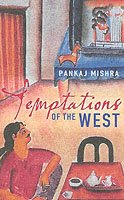
Pankaj Mishra likes to swim against the tide. When the world is singing paens to India's economic miralcle, Mishra writes an op-ed in the NYT questioning the fundamentals behind the assumption of India's miracle. And he marshalls some convincing data to prove his point:

"INDIA is a roaring capitalist success story." So says the latest issue of Foreign Affairs; and last week many leading business executives and politicians in India celebrated as Lakshmi Mittal, the fifth richest man in the world, finally succeeded in his hostile takeover of the Luxembourgian steel company Arcelor. India's leading business newspaper, The Economic Times, summed up the general euphoria over the event in its regular feature, "The Global Indian Takeover": "For India, it is a harbinger of things to come — economic superstardom."

"This sounds persuasive as long as you don't know that Mr. Mittal, who lives in Britain, announced his first investment in India only last year. He is as much an Indian success story as Sergey Brin, the Russian-born co-founder of Google, is proof of Russia's imminent economic superstardom."

"...The main reason for this is that India's economic growth has been largely jobless. Only 1.3 million out of a working population of 400 million are employed in the information technology and business processing industries that make up the so-called new economy."

I agree with Mishra's conclusion--we need to do a lot of work before we can rightfully claim that the 21st century is the century of India: "Many serious problems confront India. They are unlikely to be solved as long as the wealthy, both inside and outside the country, choose to believe their own complacent myths."

Friday, July 07, 2006

What's in a name?


Probably a lot. That's why some places are wiped off the map, says Mark Monmonier in his book, From Squaw Tit to Whorehouse Meadow.

Mark says: "'Nigger's were abolished in the US in 1962. 'Squaw's and 'Jap's went in the decade following. The erasure of 'Dago's, 'Chink's and 'Wop's has been a more piecemeal affair. In From Squaw Tit to Whorehouse Meadow, Mark Monmonier reads map names to diagnose the racial, political and moral tensions which enmesh them. A toponym (the name of any feature that appears on a map), he argues, is both a legacy and an argument waiting to happen."

Name of places do fascinate me. If you go into the heartland of India, or for that matter, any other country, you will notice how the names of the places are linked with local language and folk lore. These days in the metros, however, you will find more anglicised names than ever before. In Delhi's suburb Gurgaon, for example, you will find a lot of apartment buildings named as Ridgewood and Hill View Apartments in Pocket so and so and Zone so and so.

Sometimes, even your name could have a geographical existence. I was really surprised to find out that my name stood for two different places in different parts of the world: Zafar in Oman and Anjum in the Netherlands. Interesting, isn't it?

Thursday, July 06, 2006

Who's the voice of this generation?


Asks Lev Grossman in this Time magazine article.

" David Foster Wallace is 44 years old. Jonathan Franzen is 46. Jonathan Lethem, 42. Michael Chabon, 43. I point that out not to be rude--although I admit it is kind of rude--but because those are the writers that people--people who think about such things, anyway--think of as the young American novelists. And even by the notoriously elastic standards of the literary world--the only place on earth where you can still be a wunderkind at the age of 30--42 is not especially youthful. Wallace, Franzen, Lethem and Chabon may be great writers, but one thing they are not is young writers."

He goes on and then concludes:

"That probably gets at some of the truth of it. The world has changed, and the novel has changed with it. Fictional characters just can't get away with being generically white and middle class and male anymore, the way they used to. Not and still be the object of mass identification and adoration the way the Voice has traditionally been. We just don't think about people that way anymore: we're interested in the specifics of their racial and ethnic and historical circumstances, where they came from and who made them that way. If the novelists under 40 have a shared preoccupation, it is--to put it as dryly as possible--immigration. They write about characters who cross borders, from East to West, from Old World to New and back again, and the many and varied tolls they pay along the way. Their shared project, to the extent that they have one, is the revision of the good old American immigrant narrative, bringing it up to code with the realities of our multicultural, transcontinental, hyphenated identities and our globalized, displaced, deracinated lives. It's a literature of multiplicity and diversity, not one of unanimity, and it makes the idea of a unifying voice of a generation seem rather quaint and 20th century. I may love and empathize with the transplanted Bengalis who populate Lahiri's fiction, or Shteyngart's semi-Americanized Russians, or Foer's uprooted Old Worlders or Smith's international extended families. But I would never be so foolish as to mistake any of them for myself."

That's an interesting thought there. Reading experience, in this age of TV and rich media and what not, is not the same any more.

But to think of India in this context, thankfully there are a number of 30 or below 30 something novelists--whether they represent the voice of this generation is a differet matter.

Interestingly, in a poll in the same issue, to see the emergence of a classic novel written by the recent crop of writers, Zadie Smith and Jhumpa Lahiri are on the tops (at least as of now).

Sunday, June 25, 2006

Krrish invokes mixed reactions


Rakesh Roshan's Bollywood bonanza Krrish, his sequel to the super hit Koi Mil Gaya, starring his star son Hrithik Roshan, has been one of the most awaited movies of the year in Bollywood circles. For months, it has been promoted as India's first Superhero movie. The action sequences and special effects were tauted as the best Bollywood had ever seen. In fact, Roshan Sr said in an interview that "It (special effects) is not like Hollywood. It is Hollywood."

For me and many watchers, Krrish has been special also because it was extensively (60%) shot in Singapore. Singapore Tourism Board (STB) invited the Roshans to shoot the movie here and promote Singapore, hoping to repeat the Roshan effect on Indian tourists what they had seen in the case of New Zealand (Roshan's earlier film Kaho Na Pyaar Hai was shot in NZ and it had apparently increased the tourist influx to NZ many times over).

I haven't seen the film yet but the reviews have been kind of mixed.

Rajiv Masand says in IBNLive: "Yes, Krrish may actually be Bollywood's first stab at a superhero story, and the intention is commendable, but the effort leaves a lot to be desired." He adds: "My biggest complaint against Krrish is directed towards its screenplay: It stinks."

Sukanya Verma says in Rediff.com: "The production values are shoddy. SFX team of Marc Kolbe and Craig Mumma's shabby use of super imposed background is annoying and distracting. Cinematographer Santosh Thundiiayil could have opted for a darker, slick look. Instead, he lends Krrish an extra-bright and powdery appearance befitting a detergent commercial. Siu Tung Ching and Sham Kaushal's action gets no points for originality. Most of it is borrowed from Matrix flicks and is repetitive in nature. Surely there must be more to a superhero than surging from one pole to another. This gratification comes to you only in the tail end of the movie. Krrish neither has the sleek aura nor the deep-rooted ideology of superheroes. What it does have is a super spirited performance from Hrithik Roshan, which is likely to appeal to kids. And that's worth a three-star cheer."

Raja Sen in Rediff.com has another view to offer: "Do the Krrish writers succeed? Not really. While luxuriously taking up almost three full hours of screentime, they plod through an extremely derivative landscape. Ideas are borrowed from a bunch of movies -- the few people who have watched John Woo's Paycheck will feel some déjà vu -- and effect-shots from a million more, including The Matrix films, Spider-Man, and Crouching Tiger Hidden Dragon. And watch out for the distinct Batman hangover when he actually dons the mask. Krrish is mired by predictability. There are no big revelations, no sudden surprises. There's also no real character involvement, the viewer not actually caring enough about Krrish but just, like the protagonist himself, caught up in all his contrived coolth. However, the fact that it's exactly what the KMG fan expects is the reason the sequel will actually succeed. I'd bet on a sequel to Krrish."

That is a bit positive. More positive is Diganta Guha in The Hindustan Times: "Technically, Krrish is perhaps the best in Bollywood history, whether in terms of action, special effects, cinematography or sound. There's little for the actors to do but deliver their bit and let Roshan Sr take the credit for a brilliant package...The sleek action sequences by Hong Kong-based Tony Ching Siu Tung and Sham Kaushal set a new trend, and combined with the special effects by US-based Marc Kolbe and Craig Mumma, they are a treat to watch...Krrish is a breath of fresh air into the staid world of Bollywood, much like Sanjay Leela Bhansali's Black. Watch it for its own sake and feast your eyes on the spread Roshan Sr has laid out for you."

Wah! That is a wonderful review for Krrish. Roshans must be happy to read this but the site looks like the official promotional site of Krrish.

Surprisingly, none of the above mentioned reviews have mentioned, not even once, the breathtakingly beautiful scenes from Singapore and how well Roshan has exploited their picture postcard prettiness!

In fact, on the other side of the Singapore River, Singapore's Today film reviewer had some complaints against Roshan's portrayal of Singapore in "A prosaic portrayal: Krrish makes Singapore look uninteresting" (June 24, 2006):

"There is a good reason why so many Singaporean film-makers choose to set their films in Singapore's grittier spaces: There is little that is interesting about Singapore's snazzy side. And that is one of the problems with the blockbuster-wannabe Krrish — the first Bollywood film to be funded under the Singapore Tourism Board's $10-million Film in Singapore! Scheme."

"It doesn't make Singapore look terribly interesting."

In this sequel to the 2004 hit Koi Mil Gaya, Hrithik Roshan plays Krishna, a man with supernatural powers — his father was, wait for it, empowered by an alien called Jadoo — who falls in love with Priya (Priyanka Chopra) and follows her to Singapore. The problem is, Priya initially wants only to exploit his powers to score a hit show for the TV station where she works. So, Krishna and Priya go traipsing through Singapore's most prominent places in their courtship. Audiences get to see Shenton Way, Sentosa, Chinatown and Boat Quay filmed in the most prosaic ways. Buy a postcard and you'd get the same picture."

"Perhaps to add interest to banality of the setting, the film also portrays a seedier Singapore that doesn't really exist. As Krishna steps out of Changi Airport, two thugs on a motorcycle try to grab his belongings. And if the film is to be believed, Clifford Pier is a hangout for motorcycle thugs who speak bad English."

Whatever the criticism and irrespective of Krrish's aforementioned weaknesses, the film is going to increase the Indian tourist inflow to Singapore. After all, millions of Indians seeing the beautiful Singapore shots in the Krrish songs playing on their telly day and night won't be able to ignore the charm of the lion city.

Kitaab@APWN

There is this interesting news that I want to share with you. My website, Kitaab, has been featured in APWN (Asia Pacific Writers Network, an initiative of PEN Australia). Along with my editorial, writings by my friends Fakrul Alam, Deepika Shetty and Jai Arjun Singh have also been showcased. Take a peek here.

India vs China: Is the world really 'flat'?


Sorry for digressing from my pet topic of books and writers this week. I find the India vs Chian debate extremely engrossing as it concerns our own future. A good debate on the two rising economies has been going on for quite some time now.

Here is an interesting podcast, which in fact provides a radically different view on this topic (TiECON East 2006: Howard Anderson Keynote on India & China: Is the World Flat or “Spiky”?)

Venture capitalist Howard Anderson, in this podcast, predicts the position of India and China in the next 20 years.

Anderson says that India has a temporary advantage and it might lose the game if it does not move towards development of proprietory software and increase its manufacturing base (Amartya Sen said the same thing in a BBC interview a few days ago). India already employs about 10,000 foreign workers (from US, Europe as it is suffering from shortage of skilled workers!!) and the salaries of its workers are steadily increasing--damaging India's cost advantage (No wonder recently Apple decided to shut down its outsourcing lab there; Another company, a British power company, also recently closed down its call centre business in India).

China is developing its physical as well intellectual infrastructure at a great speed. It seems to be at a more advantageous position.

Saturday, June 24, 2006

America on the decline?


While the media is agog with stories of China and India rising and becoming great economic powers, America's decline as a technological innovator (and obliquely as a power) is also being discussed a lot these days. Recently, Newsweek ran a cover story on this theme titled, Can America Compete?

Writes international editor of Newsweek, Fareed Zakaria:

"Well, Americans have replaced Britons atop the world, and we are now worried that history is happening to us. History has arrived in the form of "Three Billion New Capitalists," as Clyde Prestowitz's recent book puts it, people from countries like China, India and the former Soviet Union, which all once scorned the global market economy but are now enthusiastic and increasingly sophisticated participants in it. They are poorer, hungrier and in some cases well trained, and will inevitably compete with Americans and America for a slice of the pie. A Goldman Sachs study concludes that by 2045, China will be the largest economy in the world, replacing the United States.

It is not just writers like Prestowitz who are sounding alarms. Jeffrey Immelt, CEO of GE, reflects on the growing competence and cost advantage of countries like China and even Mexico and says, "It's unclear how many manufacturers will choose to keep their businesses in the United States." Intel's Andy Grove is more blunt. "America ... [is going] down the tubes," he says, "and the worst part is nobody knows it. They're all in denial, patting themselves on the back, as the Titanic heads for the iceberg full speed ahead."

"Much of the concern centers on the erosion of science and technology in the U.S., particularly in education..."

In another relevant story, "The fast-fading luster of the American story" in IHT,
Nathan Gardels and Mike Medavoy conclude that America's soft power (its cultural exports) is on the wane. I have been thinking along these lines, and their ideas strike a chord with me--didn't somebody great minds think alike?

"This vast influence of American culture in the world is what Harvard professor Joseph Nye has called "soft power."

Now, however, we are witnessing a mounting resistance, particularly from Asia and the Muslim world, to the American media's libertarian and secular messages.

There is also resistance to the mere fact of America's overwhelming cultural dominance. Josef Joffe, the publisher-editor of the German weekly Die Zeit, has put it directly: "Between Vietnam and Iraq, America's cultural presence has expanded into ubiquity, and so has resentment of America. Soft power does not necessarily increase the world's love for America. It is still power, and it still makes enemies."

If, as Nye has said, politics in the information age is about whose story wins, America's story, which has won for so long, is losing its universal appeal.

Fewer and fewer are buying into the American narrative. Needless to say, that has big implications for America's storyteller - Hollywood - as well.

America's soft power is losing its luster for several reasons."

Now read on to know those reasons. The piece is thought-provoking.

Sunday, June 18, 2006

Minorities in Malaysia

I seldom write about politics here in my blog but this one is special. Fellow blogger, Sharanya Manivannan, sent me this link to her open letter to the Prime Minsiter of India. Sharanya forcefully talks about the despicable state of minority rights in Malaysia-- a real cause for concern. Reading her account makes me shudder at the dangers of radical Islam. Only yesterday I read the news that some Muslim clerics in Malaysia wanted to impose a ban on general Muslims from attending religious festivities of other religions. Thankfully moderate Malaysians have criticised such remarks. The same spirit and more needs to be shown for minority rights as well.

Read the open letter here.

A discussion on this topic is already on at Sepia Mutiny.

Fishwick does a la David Davidar and Dalrymple catches big fish

Michael Fishwick of Bloomsbury has done a la David Davidar. The publisher and cheque-writer has turned a fairly successful novelist. When I read about him here, I got reminded of David Davidar. Davidar was the CEO of Penguin Books India when he sent off his novel, The House of Blue Mangoes, to the most famous lit agent in London, of course under a different name. Fishwick did the same thing, and you know, he sent his ms to the same agent! Pure coincidence! Looks like Atundhati Roy's agent is the publisher's favourite too.

In the same interview, we get to know that Dalrymple has signed a huge deal with Bloomsbury that has caused some controversy in the publishing industry:

"But he stiffens at mention of the Dalrymple deal. "It wasn't wildly more than he was being paid at HarperCollins," he says sniffily. The reports ignored the small print, he adds. The £2m is for five books. "His last book sold 50,000 in hardback and will have sold 200,000 in paperback. All William's books sell 5,000 or 6,000 copies a year and have done since I first published him in 1987. So, in terms of where you are going to put your money, it is as safe a bet as you can think of."

Last Words

Harper Lee's has been a curious story. She did not publish anything after her first hugely successful novel, To kill a mocking bird.

Here is some light on her rather mysterious life:

Harper Lee's last major interview was given to Roy Newquist in March 1964, for his book 'Counterpoint'

"I never expected any sort of success with Mockingbird. I was hoping for a quick and merciful death at the hands of reviewers, but at the same time I hoped that maybe someone would like it enough to give me encouragement - public encouragement. I got rather a whole lot, and in some ways this was just about as frightening as the quick, merciful death I'd expected.

[My next book] goes ever so slowly. Many writers really don't like to write ...They loathe the process of sitting down trying to turn thoughts into reasonable sentences. I like to write - sometimes too much because when I get into work I don't want to leave it. I'll go for days and days without leaving the house. I'll go out long enough to get papers and pick up food and that's it.

This was my childhood: if I went to a film once a month it was pretty good.

We had to use our own devices in our play, for our entertainment. We didn't have much money. We didn't have toys, nothing was done for us, so we lived in our imagination most of the time. We were readers, and we would transfer everything we had seen on the printed page to the backyard in the form of drama.

It takes time and patience and effort to turn out a work of art, and few people seem willing to go all the way. I see a great deal of sloppiness and I deplore it. I think writers today are too easily pleased with their work. This is sad. There's no substitute for struggling, if a struggle is needed, to make an English sentence as beautiful as it should be.

I want to do the best I can with the talent God gave me. I would like to leave some record of... small-town middle-class southern life. All I want to be is the Jane Austen of south Alabama."

John Updike, Terrorism, and the Future of Books


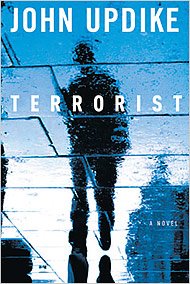
These days terrorism is a hot topic for novelists. Both Yasmina Khadare and John Updike have come out with new novels that have terrorism as their central themes. While Yasmina Khadare's novel is titled "The Attack," Updike's is simply called "Terrorist."

Here's a review of Updike's novel by NYT's Michiko Kakutani:

"Unfortunately, the would-be terrorist in this novel turns out to be a completely unbelievable individual: more robot than human being and such a cliché that the reader cannot help suspecting that Mr. Updike found the idea of such a person so incomprehensible that he at some point abandoned any earnest attempt to depict his inner life and settled instead for giving us a static, one-dimensional stereotype.

"Terrorist" possesses none of the metaphysical depth of classic novelistic musings on revolutionaries like "The Secret Agent," "The Possessed" or "The Princess Casamassima," and none of the staccato, sociological brilliance of more recent fictional forays into this territory, like Don DeLillo's "Mao II."

However, this is not going to dampen my spirits. I look forward to reading these two novels.

Here is another link (podcast) to Updike's speech on the future of books. Quite interesting!

Thursday, June 01, 2006

In Lust We Trust?


Singaporean author Gerrie Lim is back with a bang, and his new book is lustier than his previous outputs: It is befittingly called, In Lust We Trust!

Lim was a scribe in the US in the yester years and used to cover the music industry and later on the porn industry there.

He got famous with his book on the escort business: "His 2004 book Invisible Trade, an expose on the upscale escorting industry, is in its third printing and has sold an impressive 20,000 copies."

Lim has used his porn industry experience (of covering it) to write his latest, what looks like, bestseller. In an interview with Today, he made some interesting points:

"I think that a lot of us are inherently voyeuristic, whether we like it or not. The people who deny it are obviously lying. The fact that someone bothers to watch a reality show where people make fools of themselves is voyeuristic, not to mention more exploitative than pornography."

"Of course, adult entertainment has been demonised and there is no way around that. It's like writing a book about professional wrestling and explaining it to people who think it's stupid. Well, stupid is the point. It's funny and not real because it's not sports but entertainment."

"It's the same with porn. Adult actress Nina Hartley gave me a great quote when I was researching this book: "You've got to remember that porn is basically live action sex cartoons."

If you can't hold it anymore and read the whole stuff, go here.

The Birth of a Jehadi


In its latest issue, New Yorker takes a look at the phenomenon of Muslim Jehadis, in the context of the last year's London bombings. The article quotes from a British investigation report and shows respect for its conclusions:

"The report concludes that there is no consistent profile that could be used to help identify who might be vulnerable to such radicalization, and yet the biographies do show in some detail how the making of an Al Qaeda-inspired suicide bomber is an idiosyncratic narrative of push and pull. Alienation from citizenship or family and a loss of faith in secular opportunity create a pool of potential volunteers; preachers, recruiters, and Al Qaeda leaders take it from there. The British parliament’s main intelligence-oversight committee, in a separate report, admits that Britain has failed to consider adequately how it might reduce the number of potential recruits: “We remain concerned that across the whole of the counter-terrorism community the development of the home-grown threat and the radicalisation of British citizens were not fully understood or applied to strategic thinking.”

In the same issue, Margaret Talbot profiles the famous Italian journalist Oriana Fallaci and her views on Islam.

In the piece, there is this interesting anecdote about Fallaci' meeting with Khomeni:

"Fallaci continued posing indignant questions about the treatment of women in the new Islamic state. Why, she asked, did Khomeini compel women to “hide themselves, all bundled up,” when they had proved their equal stature by helping to bring about the Islamic revolution? Khomeini replied that the women who “contributed to the revolution were, and are, women with the Islamic dress”; they weren’t women like Fallaci, who “go around all uncovered, dragging behind them a tail of men.” A few minutes later, Fallaci asked a more insolent question: “How do you swim in a chador?” Khomeini snapped, “Our customs are none of your business. If you do not like Islamic dress you are not obliged to wear it. Because Islamic dress is for good and proper young women.” Fallaci saw an opening, and charged in. “That’s very kind of you, Imam. And since you said so, I’m going to take off this stupid, medieval rag right now.” She yanked off her chador."

Fallaci has written a lot on Islam and the West in recent years. The profile further notes:

"She writes that Muslim immigration is turning Europe into “a colony of Islam,” an abject place that she calls “Eurabia,” which will soon “end up with minarets in place of the bell-towers, with the burka in place of the mini-skirt.” Fallaci argues that Islam has always had designs on Europe, invoking the siege of Constantinople in the seventh century, and the brutal incursions of the Ottoman Empire in the fourteenth and fifteenth centuries. She contends that contemporary immigration from Muslim countries to Europe amounts to the same thing—invasion—only this time with “children and boats” instead of “troops and cannons.”

Meanwhile, in the NYRB, Michael Massing somewhat rises to the defence of two American researchers who have done a controversial paper on the Israel Lobby in America.

"Not since Foreign Affairs magazine published Samuel Huntington's "The Clash of Civilizations?" in 1993 has an academic essay detonated with such force as "The Israel Lobby and US Foreign Policy," by professors John J. Mearsheimer of the University of Chicago and Stephen M. Walt of Harvard University's Kennedy School of Government. Published in the March 23, 2006, issue of the London Review of Books and posted as a "working paper" on the Kennedy School's Web site, the report has been debated in the coffeehouses of Cairo and in the editorial offices of Haaretz. It's been called "smelly" (Christopher Hitchens), "nutty" (Max Boot), "conspiratorial" (the Anti-Defamation League), "oddly amateurish" (the Forward), and "brave" (Philip Weiss in The Nation). It's prompted intense speculation over why The New York Times has given it so little attention and why The Atlantic Monthly, which originally commissioned the essay, rejected it."

Worth a read as it gives interesting insights into the working of political lobbies in the US.

Tuesday, May 30, 2006


Flamingoes in the Jurong Bird Park, Singapore.  Posted by Picasa

Has Londonstani sent the 'novel' for a Holiday this season?


Looks like, yes, if you read this Observer article. It says that the novel has lost its way!!

"This obsession with literary fashion comes at a price. Consider the sad story of Londonstani, a first novel by a talented young Asian writer named Gautam Malkani. Hype aside, this spirited coming-of-age story, narrated by Jas, a Hounslow schoolboy, in a mish-mash of patois, rap, text messaging and west London street-talk, is a promising debut. If it had been published, as its author once intended, as a teen novel, it might have found a secure place as a contemporary classroom cult.

Alas, everything about its short life has been a disaster. Once Fourth Estate, hungry to cash in on the White Teeth and Brick Lane market, had paid an advance in excess of of £300,000, the die was cast. Thereafter, Londonstani had to be 'the literary novel of the year'. Like a Fiat Uno entered for Formula 1, after a squeal of brakes and a loud bang, Londonstani was reduced to a stain of grease, and some scraps of rubber and tin, on the race track of the 2006 spring publishing season. In Borders or Waterstone's, Londonstani is already being airbrushed from history. The celebrity culture of which contemporary fiction has become an uneasy part has no use for failure, or the garret.

From almost every other point of view, and certainly for the consumer, this can occasionally seem like a golden age for books, in which it is impossible to overestimate the impact of the IT revolution. Certainly, the microchip and the internet have transformed booksellers, rejuvenated publishers, galvanised readers and given unpublished writers the kind of audience they had hitherto only dreamed of. Moreover, that truly modern phenomonenon, the blog, has enfranchised a new group of wannabes, creating the sensations of authorship (with none of the pain). Now almost everyone is a published writer. Literary life has become, perhaps for the first time, global, democratic and uninhibited. The bookshops are better equipped and the books they sell are better printed, better designed and better marketed than ever before. There's a huge audience, and apparently no shortage of money. It's an almost perfect environment for a new writer of talent.

But here, finally, is the irony. The greatest IT revolution since Gutenberg, a voracious marketplace, and the transformation of the novel's ambitions, has created a perfect cultural climate for someone 'to do the whole marvellous scene in one gigantic daring bold stroke' - and what do we find ? Despite an impressive showing by Booker in 2004 and 2005, elsewhere in the literary marketplace Fiction, the New Self-Expression, has become a cocky, well-paid and slick appendix to Hello! This is Lit. Lite, offering a short route to a quick buck, a blast of instant celebrity and a text devoid of consequence or meaning. Aptly, one of this season's hottest literary properties is a novel called Tourism, a case study in such packaging. When its author, Nirpal Singh Dhaliwal, published a savage review of Londonstani, perhaps only a Swift or a Shaw could do justice to the spectacle of apprentices wrestling in mud for the keys to the gates of Parnassus. It makes one strangely nostalgic for the bad old days of FR Leavis."

If the novel has really lost its way, I wonder where are all these wannabe novelists headed?

Laila Lalami in 'African Booker' Shortlist


Known as the 'African Booker', the $15,000 (£9,000) prize is awarded to a short story published in English by an African writer whose work reflects African sensibilities.

Laila Lalami, a Moroccan-born author, has been nominated for The Fanatic, a chapter from her novel Hope and Other Dangerous Pursuits. The book tells of four Moroccans who cross the straits of Gibraltar on a lifeboat in order to emigrate to Spain. According to Lalami, who now lives in Oregon and is the editor of the literary blog Moorishgirl.com, the story was inspired by an article she read in Le Monde in 2001 about 15 Moroccan immigrants who drowned while crossing the straits of Gibraltar in a fishing boat.

Read the full news here.

Wednesday, May 17, 2006

Beloved


In a survey by the New York Times, Toni Morrison has emerged as the beloved of the literati, of course, as an American writer. We can't even call it a prejudiced view or an colored opinion, right? But some do find a problem with this choice. Read more here.

In another notable development, did you think that authors are solitary creatures, and they don't need any company? If you did then think again. Here is a report by NYT:

"With authors fiercely battling for attention in a media-saturated world, an increasing number of writers — from first-time novelists like Ms. Dean to celebrities like Madeleine K. Albright, the former Secretary of State — are visiting people where they spend much of their time: at work." (Authors Meet Fans Far From Bookstores, at Company Events)

Londonstani


Ok, ok, I am late in talking about Gautam Malkani and Londonstani (almost rhymes). Actually, we were all so much caught up with the Kaavya episode that we completely forgot to celebrate this English author of Indian origin who has penned a novel titled Londonstani. For those who judge an author by the amount of advance he got, Malkani should impress. As the story goes, Malkani reportedly got an advance of, ahem, 300,000 Euros in Frankfurt Book Fair. Now, in dollar terms, that is more than what Kaavya got, right?

The novel is also making waves for its lingiuistic cleverness and the issues of identity and gender. Please see the links at Kitaab.

Malkani has been working with the Financial Times for the last seven years. He studied at Cambridge. Aren't you impressed enough to buy the book?

Sunday, May 07, 2006

Sex and the tale of two cities


Two sperate events but linked by sex, and Muslim sentiments are involved in both the cases. One takes place in Jakarta, in the capital of the Islamic state of Indonesia. Another in the Muslim dominated state of Jammu and Kashmir in India.

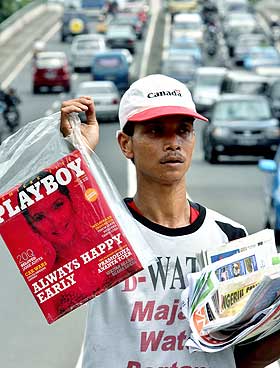
In April, according to reports, hardline Indonesian Muslims vandalised the office of Playboy magazine, protesting against its publication in that country, also the world's most populous Muslim nation. The protesters also destroyed several copies of the Indonesian Playboy, which unlike the U.S. original does not show any nudity. Despite being a much tamer version, the magazine sold out very quickly, thanks to controversy surrounding its publication.

Following strong protests, Playboy Indonesia has decided to delay its second edition for security reasons.

In Kashmir, angry Muslims have reacted over a sex scandal allegedly involving some former ministers. They destroyed the house of Sabina, the alleged kingpin of the sex scandal, and set her belongings on fire.

The report says that the sex racket was exposed after police seized a CD containing pornographic clips of a young girl, Sabina, who said that several politicians and police officials forced her into prostitution.

While the Indonesian magazine is on hold amid questions of freedom of expression and Islamic laws, it remains to be seen if the exploitative Kashmiri politicians and officers are going to be identified and prosecuted.

Bollywood lessons


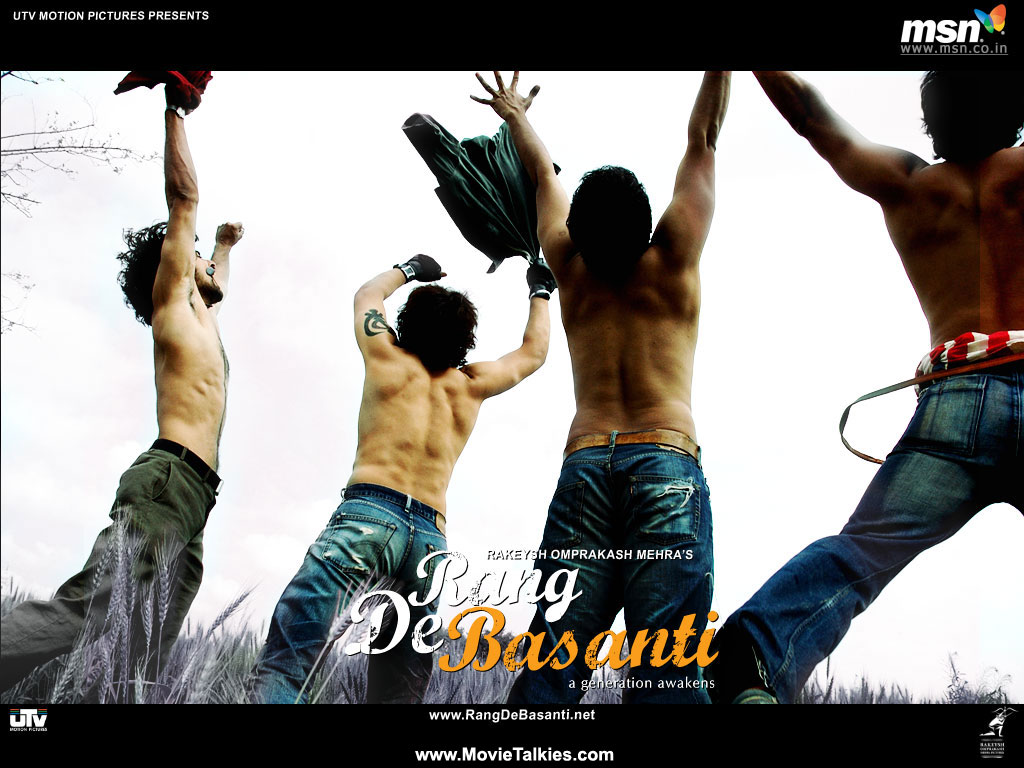
Bollywood is making waves these days--both at home and abroad. As 'Sholay' enters school textbooks, school teachers in Delhi are being exposed to more films from the Mumbai film industry. As per a report in The Hindustan Times, the Delhi government is holding special screenings of Munna Bhai MBBS and Rang De Basanti as a part of its teachers' training programme.

It is definitely an interesting way of training teachers. And both the films are remarkable in their own ways.

A few years ago, we too made a documentary film (India's economic transition through Bollywood) that showed India's economic milestones through clips of scenes gleaned from hundreds of films. India's two maverick economists, Amir Ullah Khan and Bibek Debroy, had piloted the project. The film was shown in management schools across India.

Recently, Google has also funded a non-profit venture in India that uses Bollywood film songs as a literacy tool. Great going Bollywood!

Sholay in school text books


Ramesh Sippy's Sholay (1975) is India's one of the most loved and talked about films ever. It has been loved by generations of Indians, and it enjoys the distinction of being India's first biryani western. On the Indian box office it has been one of the top ten grossers of all time. In short, it has many firsts and records to its credit.

The latest distinction achieved by Sholay is academic. It is the first Indian film to be included in a school text book:

"For the first time in the history of Indian academia, an entire chapter in a school textbook will be devoted to a mainstream Bollywood blockbuster.

Ramesh Sippy’s multi-starrer Sholay has been added to the Broadway course workbook No 5 for Class V students of CBSE.

"Published by Oxford University Press, the inclusion of Sholay is a continuation to the chapter on films and film-making in the Broadway book, which is designed to help students communicate effectively and accurately in English.

"The National Curriculum Framework 2005 postulates that the multi-lingual character of our society be treated as a resource and school teaching should focus on what the child understands. Since films are an integral part of our culture and Sholay is one of the most influential films, it has been included in the course, said sources.

"The text on films and filmmaking in the course book and Sholay in the workbook is a representation of Indian drama in the life of a child. The choice of Sholay was made because it is a different film in many ways. Besides,we wanted children to be aware of the prominence attached to the Indian film industry," said an insider." (The Times of India, April 29)

More on Sholay is here.

Saturday, April 29, 2006

Kaavya's Opalgate


At first, I was reluctant to blog about this issue, but ever since the plagiarism news got broken in The Harvard Crimson, the floodgates of comments and blogs opened, and Harvard Sophomore Kaavya Viswanathan has been pilloried uncessantly.

I am not writing this post to defend Kaavya here. Nor do I support any act of plagiarism (though copycat Bollywood does it all the time but no one touches its whiskers). Not 14 as initially reported but about 39 counts of plagiarism were found in Kaavya's novel, How Opel Mehta Got Kissed, Got Wild and Got A Life. Interesttingly, the novel was not selling like hot cakes. It was not on the NYT bestseller list. At Amazon, it was at some 300+ rank. Once the controversy broke out, Kaavya has hit the international headlines. She has become one of the top ten searches at Technorati.

Is this a story of getting all the glory (the USD 500,000 advance, a movie deal, international coverage) for an eighteen year old and then giving everything away, nosediving into the abyss of disrepute? Or there is something more to it than what meets the eye?

I guess people should pay attention to a NYT report that addresses this angle:

"Nobody associated with the plagiarism accusations is pointing fingers at Alloy, a behind-the-scenes creator of some of the hottest books in young-adult publishing. Ms. Viswanathan says that she alone is responsible for borrowing portions of two novels by Megan McCafferty, "Sloppy Firsts" and "Second Helpings." But at the very least, the incident opens a window onto a powerful company with lucrative, if tangled, relationships within the publishing industry that might take fans of series like "The It Girl" by surprise."(The NYT)

Look at these important facts and decide for yourself:

1. On the copyright page of Kaavya's novel — and the contracts — there's an additional name: Alloy Entertainment

2. The relationships between Alloy and the publishers are so intertwined that the same editor, Claudia Gabel, is thanked on the acknowledgments pages of both Ms. McCafferty's books and Ms. Viswanathan's "How Opal Mehta Got Kissed, Got Wild, and Got a Life."

3. Alloy owns or shares the copyright with the authors and then divides the advances and any royalties with them.

4. The publishing contract Little, Brown signed is actually with Alloy, which holds the copyright to "Opal" together with Ms. Viswanathan. Neither Little, Brown nor Alloy would comment on how much of the advance or the royalties — standard contracts give 15 percent of the cover price to the author — Ms. Viswanathan is to collect.

5. After the breaking out of the controversy, both the books have gone up in the Amazon.com rankings. It means sales of these two books multiplied.

6. Ms. McCafferty, from whose novels Kaavya has stolen the phrases, has clearly said that she was not pressing any legal charges against the erring author.

7. Kaavya has gone on leave from her school. In a few week's time, the story will be forgotten, and Ms Kaavya will go on with her normal life.

Based on the above, please make up your own mind. And let me know if you have anything to say on this.

Wednesday, April 26, 2006


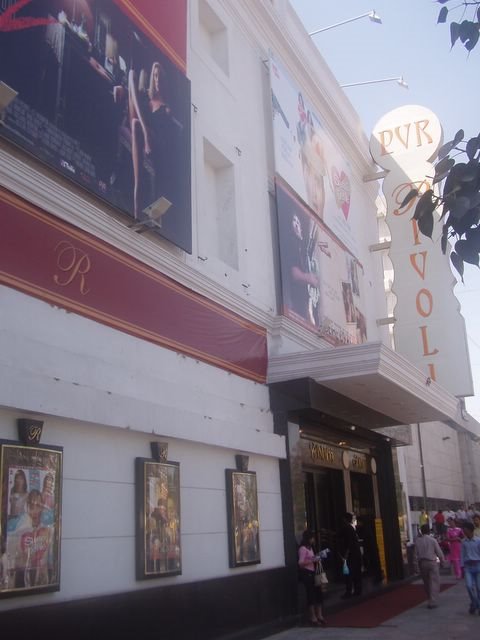
Rivoli Theatre in Connaught Place Delhi--the once seedy cinema hall has got a facelift under the PVR Cinemas, the new owners. You can see the poster of Basic Instinct 2 on the wall.  Posted by Picasa

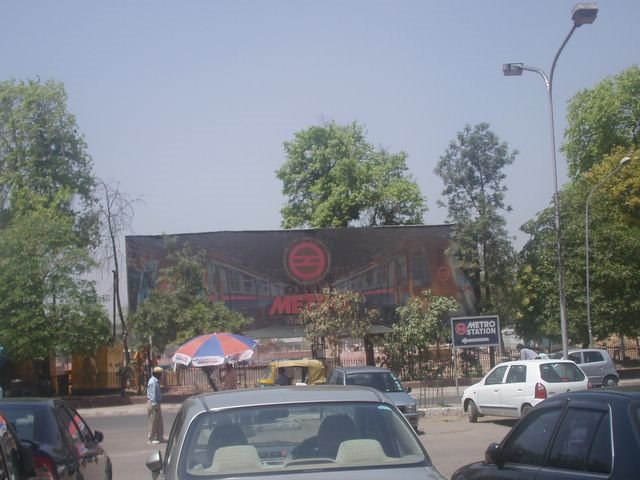
Delhi's Metro, under construction at Connaught Place, the heart of Delhi. Delhiites are proud of the Metro Network. A view from the outside (from a recent trip to Delhi) Posted by Picasa

Thursday, April 06, 2006


Rising China: Picture taken at the Careers 2006 Exhibition, Suntec City, Singapore  Posted by Picasa

Wednesday, March 29, 2006

Hong Kong steps onto the international literary stage


While Singaporeans/Malaysians keep sqabbling over Singlish/Minglish vs Queen's English, Hong Kong has been taking great strides in the literary arena.

The IHT reports: "...Hong Kong becomes home to a new international literary prize and to the relaunched Asia Literary Review. Major overseas publishers and agents, meanwhile, have been making regular visits or setting up operations in this area.

"The fear that Hong Kong would lose its English-language heritage after the 1997 handover from British to Chinese rule now seems misplaced...

"At the same time, greater China is playing an increasingly important role on the international literary scene. More Asians are learning English and buying more foreign books. Meanwhile, American and British publishers are becoming more interested in Asian writers, particularly young Chinese ones, whose works have the potential to sell well in the West.

Hong Kong is working hard to position itself in the middle of this potentially booming book trade. Last week Man Investments announced it would sponsor a new Hong Kong-based literary prize starting in the autumn of 2007 - its only literary prize aside from the two prestigious Booker awards. According to a news release, judges will read unpublished English-language works looking for "new Asian literature to be brought to the attention of English-reading audiences around the world."


Singapore is also trying its best to promote the reading/writing culture through lietarary festivals, etc. However, there seems to be shortage of talent, which is strange. Singapore's libraries are so well stocked and all kinds of books and writing opportunities are available. Sadly, for example, this year no writer could be found worthy of the annual NUS-FASS and TOPH Writing Fellowship.

The writing fellowship had made a brilliant start in its inaugural fellow, playwright Huzir Sulaiman, and the award-giving authorities feel that his accomplishments both accurately reflect the aims and spirit of this fellowship, as well as stand to benefit the literary scene in Singapore as a whole. This year, despite an encouraging number of submissions, the judges did not feel that there was an applicant who could fulfill the aims of the fellowship.

Citizen Coetzee


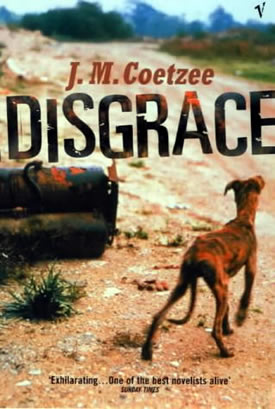
J M Coetzee is one of my favourite writers. I have recently finished reading two of his novels, Youth, and Disgrace, and have fallen in love with his sparse yet powerful writing style. Though I had read his The Life and Times of Michael K years ago, I can still recall the intensity of the experience of reading that novel and the kind of impact it had on me.

His superb novel, Disgrace ends at a situation where the disgraced protagonist, David, a former professor, is at a loss in a socio-politically changed South Africa, and as you read on the novel, you feel such pain, lonliness and purposelessness in life along with the main characters. But then, as he suggests to his daughter somewhere in the story, why doesn't she migrate to the Netherlands (?); he is ready to pay for all her expenses, and all that. And you think that why doesn't David act on his own advice--why doesn't he migrate to somewhere else if his life has so hopelessly fallen apart in SA?


Well, that's how the story ends. Now, interestingly, news is that the South African writer of Disgrace has shifted his base to Australia. He has become an Australian citizen.

He says in a report: "I did not leave South Africa because I had to," he said. "In fact I didn't so much leave South Africa — a country with which I retain strong emotional ties — as come to Australia."

Coetzee, an honorary research fellow in the English department at the University of Adelaide and the first author to twice win the Booker Prize, first visited Australia in 1991 and fell in love with Adelaide.

"I was attracted by the free and generous spirit of the people, by the beauty of the land itself and — when I first saw Adelaide — by the grace of the city," he said.

A few interesting articles

Here I am just bunching together some of the interesting articles/news items that I have read recently:


Shalimar the Clown wins Hutch Crossword Book Award


Salman Rushdie's Shalimar the Clown had a reason to smile when it won the Hutch Crossword Book Award 2005 for English Fiction. On March 21, Krishna Sobti, who wrote The Heart Has Its Reasons, and translators Reema Anand and Meenakshi Swami won the award in the Indian Language Fiction Translation category. Suketu Mehta's Maximum City: Bombay Lost and Found won in a newly introduced category for English Non-Fiction.

Literary Novels Going Straight to Paperback

Even critically acclaimed literary novels often have a short shelf life in hardcover, with one-half to three-quarters of the books shipped to stores often being returned to the publisher, unsold.

That has a growing number of publishing companies, from smaller houses like Grove/Atlantic to giants like Random House, adopting a different business model, offering books by lesser-known authors only as "paperback originals," forgoing the higher profits afforded by publishing a book in hardcover for a chance at attracting more buyers and a more sustained shelf life.

Translation Of Books Into Malay Still Scant

Translation of books in foreign languages into Malay is still scant in the country compared to other countries, Deputy Education Minister Datuk Noh Omar said Wednesday.

Tuesday, March 28, 2006

V for Vendetta


Wachowky Brothers' V for Vendetta turned out to be a gripping fare. Though I am often wary of comic books making a meaningful transition to the screen (at least for me), this one scores well on this count. The film's message is so relevant, and comes loud and clear by the end of the movie. The blowing up of the British Parliament by the revolutionary (tagged 'terrorist' by the government and the media) V and his protege, Evey (Natalie Portman with a shaved head) clearly hints at the failure of parliamentary democracy in our age and how this form of governance has come to be hijacked by the wrongdoers. V says: "People should not be afraid of their governments, governments should be afraid of their people."

The hero is an idea, can be any face behind the mask--a creation of the monstrosity of the wrongdoers. V says: "Beneath this mask there is more than flesh. There is an idea, Mr. Creedy, and ideas are bulletproof." I like that.

The best part of the film is V, played by Hugo Weaving (remember Agent Smith of Matrix?). James Purefoy was originally cast as V but left the project. Hugo Weaving was then brought in to take his place, after four weeks into the shooting. Apparently, he had a great time rubbing Portman's shaved head.

Portman and Stephen Fry are also good in the film. There is an interesting sequence in the film wherein Stephen Fry, the host of a TV talk show, shows how the terrorist and the Chancellor are the one and the same. The hints are very strong if seen in terms of contemporary politics. Vull varks to the Vachowsky vrothers vor this very valuable vork of celluloid viction.

Aamir Khan speaks out against the media


The courageous Aamir Khan, one of the finest Indian actors of our generation, has lashed out at the Indian media for their ever stooping standards of journalism. The recent issue of Tehelka runs a long interview with the actor (‘Mainstream media has become like film media 15 years ago,’April 1, 2006). It was time someone pointed these things out. However, it is sad that it had to come from an actor.

He points out issues like these: "Things that are headline news now used to be tidbits or half a page meant to be entertaining. Now that’s the main story while farmers dying are being pushed to small, unimportant sections".

"The media coverage of the Gujarat riots or Jessica Lall murder are definitely
positive examples. These are the issues they should be dealing with. Issues that deal with survival and life".

"'I watch Doordarshan for news now. You have background scores now in news channels to emphasise or create the mood or emotion behind a flood or earthquake. They have
background music for Chrissakes! It’s shocking. Next you’ll have dialogue writers and sfx!"

Read the full interview here.

Only last night I watched Aamir's latest release, Rang De Basanti. It is an impressive film: technically sound, with contemporary feel, and quite rooted. Only the ending was a little melodramatic, though the director has tried to excercise some restraint (I mean it could have been worse in somebody else's hands).

Monday, March 13, 2006

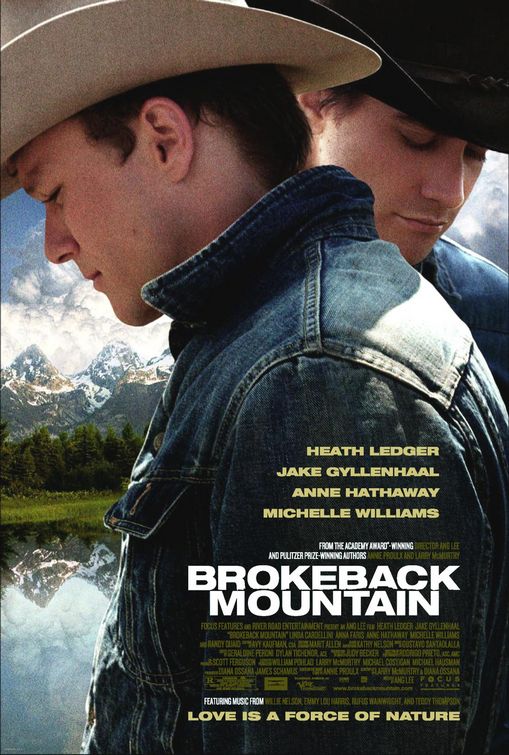
Brokeback Mountain


So, why did Brokeback Mountain finally lose out to Crash in the best picture category?

The writer of Brokeback Mountain, Annie Proulx (a) has a reason to offer:

"And rumour has it that Lions Gate inundated the academy voters with DVD copies of Trash - excuse me - Crash a few weeks before the ballot deadline. Next year we can look to the awards for controversial themes on the punishment of adulterers with a branding iron in the shape of the letter A, runaway slaves, and the debate over free silver."

In the same essay, she makes an interesting point about acting and how good acting is perceived by Hollywood:

"The prize, as expected, went to Philip Seymour Hoff-man for his brilliant portrayal of Capote, but in the months preceding the awards thing, there has been little discussion of acting styles and various approaches to character development by this year's nominees. Hollywood loves mimicry, the conversion of a film actor into the spittin' image of a once-living celeb. But which takes more skill, acting a person who strolled the boulevard a few decades ago and who left behind tapes, film, photographs, voice recordings and friends with strong memories, or the construction of characters from imagination and a few cold words on the page? I don't know. The subject never comes up. Cheers to David Strathairn, Joaquin Phoenix and Hoffman, but what about actors who start in the dark?"

Sunday, March 12, 2006

Syriana


I had missed George Clooney's "Good Night and Good Luck" but luckily I was able to catch Stephen Gaghan's "Syriana" for which Clooney won the Best Supporting Actor Award at this year's Oscars, and proclaimed from the stage, "Thank God, we are so out of touch."

Thank God there are still Hollywood actors and filmmakers like Clooney who stay out of touch with the times and make films like Syriana.

Of course, I had seen the movie before the Oscars. Brokeback Mountain had to wait. Syriana was serios business.

Stephen Gaghan (winner of the Best Screenplay Academy Award for Traffic) presents a tightly woven political thriller, weaving together many personal stories into a jigsaw-puzzle sort of narrative structure, that unfolds against the intrigue of the global oil industry. There are four basic stories here. CIA operative (George Clooney) faces his own people turned against him, young oil broker (Matt Damon) falls prey to a family tragedy and becomes advisor to an idealistic Gulf prince (Prince Nair Al-Subaani played by Alexander Siddig). Corporate lawyer Jeffrey Wright "faces a moral dilemma as he finesses the questionable merger of two powerful U.S. oil companies," while in Persian Gulf, a disenfranchised Pakistani teenager (Mazhar Munir) gets brainwashed and becomes a suicide bomber. All the four stories come together to a powerful and literally explosive climax.

I especially liked the Prince Nair Al-Subaani's character who represents the forward-looking face of the Arab world but is decimated by the powerful Oil lobby. The question that comes to the viewer's mind is: Is oil wealth and democracy incompatible and if yes, then why? I guess the answer lies more in Washington than in the Gulf region. The film is highly recommended.

But is Clooney trying to scare the public by making such films? Christopher Dickey writing in The Newsweek thinks so. His essay "Age of Anxiety" on this theme is quite interesting. On Syriana he has this to say:

""Syriana," so self-consciously obscure that even I had trouble following it, is entirely a work of fiction. Never mind the titles that say it's based on the 2002 memoir, "See No Evil" (Crown), by former CIA agent Robert Baer. The intrigues surrounding Clooney's character take place in a fictional emirate that might be Saudi Arabia, but has a history a little like Qatar and a landscape that is, quite literally, Dubai, where much of it was filmed. Yet it's not about any of those places, in fact. It's about the United States, and it's the style that's important, not the substance. "Syriana" feels like many a spy film from the 1970s, when Watergate and Senate investigations into the American intelligence establishment created a pervasive sense that government was out to defend itself regardless of the cost to American civil liberties, human rights and common sense."

Some quotable quotes from Syriana:

"In this town, you're innocent until you're investigated."

On the Arab world: "You want to know what the business world thinks of you? We think a hundred years ago you were living out here in tents in the desert chopping each others heads off, and that's exactly where you're gonna be in another hundred. So yes, on behalf of my firm, I accept your money."

On Corruption: "Corruption ain't nothing more than government intrusion into market efficiencies in the form of regulation. That's Milton Friedman. He got a goddamn Nobel Prize. We have laws against it precisely so we can get away with it. Corruption is our protection. Corruption is what keeps us safe and warm. Corruption is why you and I are prancing around here instead of fighting each other for scraps of meat out in the streets. Corruption is why we win."

Wednesday, March 08, 2006

Jarhead


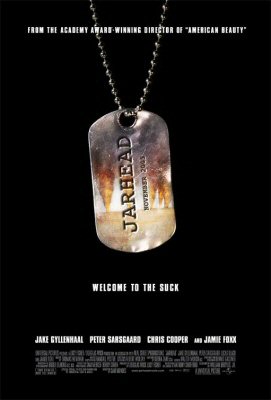
A few weeks ago when I ventured into a local cineplex, I was not sure which film to watch. What I had in mind was Jim Carrey's Fun with Dick and Jane but when I saw the poster of Jarhead with the 'Directed by Sam Mendes' tag, I knew where I was headed for. I knew it was not going to be a fun film but I was ready for some thought-provoking fare.

I was rewarded. I was watching a war movie with hardly any war happening (yeah, there were some bombing shots and the hero, a trained sniper scout, yearns for some action but gets nary a chance). There is a moment when the action-hungry protagonists almost break down when they don't get an opportunity to 'kill' their enemies. That is as satirical as one could get.

Jake Gyllenhaal, playing Anthony Swofford, is brilliant. I was watching this guy for the first time, and was not even aware that he was playing the (co) lead in the much-admired Brokeback Mountain. Others such as Jamie Foxx and Peter Sargaasard have turned in admirable performances.

I loved Jake when he mouthed lines like these (off screen):

"Suggestive techniques for the marine to use in the avoidance of boredom and loneliness. Masturbation. Re-reading of letters from unfaithful wives and girlfriends. Cleaning your rifle. Further masturbation. Re-wiring Walkman. Arguing about religion and meaning of life. Discussing in detail, every women the marine has ever fucked. Debating differences, such as Cupban VS Mexican, Harleys VS Hondas, left VS right-handed masturbation. Further cleaning of rifle. Studying the mail order bride catalogue. Further masturbation. Planning a marine's first meal on return home. Imagining what a marine's girlfriend and her man Joey are doing in the alley or in a hotel bed."

More quotable quotes are here.

'Jarhead' is based on former Marine Anthony Swofford's best-selling 2003 book about his pre-Desert Storm experiences in Saudi Arabia and about his experiences fighting in Kuwait. Filmed in the Imperial Valley in Southern California, which features conditions very similar to Iraq. Marines did use one of the local towns, Brawley, for training purposes due to similarities to Iraq. Interestingly, some desert scenes were also shot on a Universal sound stage with lights doubling as burning oil wells. The lights were later replaced with burning wells courtesy of ILM.

Tuesday, March 07, 2006

Why I love Woody Allen?


Call me whatever you want, but I can't stop loving Woody Allen. Why? His brand of humour (middlebrow?), full of people from the literary world, is hard to find anywhere else. That's why.

I loved this piece by PRADEEP SEBASTIAN in The Hindu Literary Supplement. He says on Allen:

"
Some critics now see Allen as a middlebrow sensibility masquerading as highbrow. But that's exactly why we like Allen, that's why we relate to him more than any other intellectual comic. This middlebrow sensibility is the strongest connection we have with him. It's baffling why critics valorise the lowbrow and the highbrow while mocking the middlebrow."

"Many of us intellectual, sensitive, arty types are middlebrow in our tastes and middlebrow in our sensibility. Like Allen, we too regard high culture with awe. If we can't drink deeply from it, we want to at least partake of it, want it to rub off on us."

"But often the closest we come to it is a peek at it: surrounding ourselves with Penguin classics we've never read and will probably never get to read — at least not all of them. What we possess is a smattering, a sampling of culture: we seem to know what Kafkaesque means without having read too much of Kafka, and we catch up with the great classics via movie versions of Jane Austen, Thomas Hardy, and Henry James. This, of course, is a caricature of the cultural aspirations of a middlebrow but that's what Woody Allen is all about. Allen won't be funny if this tension between the middlebrow and highbrow didn't exist."

Read the entire piece here to enjoy the discussion on "The Whore of Mensa" and "The Kugelmas Episode." Not to miss.

How do you write?

So how do you write? Standing up, sitting down, in the bathtub, on the back of your lover...

Here is an interesting article by diplomat-cum-novelist Navtej Sarna on the several odd ways of writing that famous writers have adopted from time to time. Some examples:

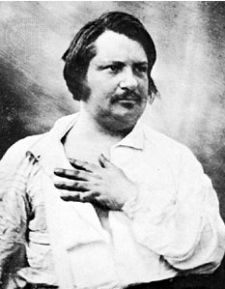
"Honore de Balzac would try and write 24 hours at a stretch and then take a five-hour break before starting over again. He consumed huge quantities of black coffee to beat fatigue and actually became a victim of caffeine poisoning at age 51. Alexander Dumas suffered from indigestion and the pain would wake him up in the small hours. He would then work on his writing desk till breakfast that usually consisted of a solitary apple under the Arc de Triomphe. His poetry would be written on yellow paper, fiction on blue and non-fiction on rose-coloured. Victor Hugo would give away all his clothes to his servant with instructions that he should not return until Hugo had completed his day's work. Ben Franklin and the author of Cyrano de Bergerac, Edmund Rostand, preferred to work in their bathtubs. Mark Twain and R. L. Stevenson could only write when lying down and Virginia Woolf, Thomas Wolfe and Lewis Carroll had to stand up to deliver. Thomas Wolfe, at least, who confessed to finding it easier to add 75,000 words than cut down 50,000 must have been very tired on finishing Look Homeward, Angel. D. H. Lawrence found stimulation in climbing mulberry trees in the nude. Voltaire used his lover's back as a writing desk."

"The poets, of course, had favourites of their own: Coleridge is said to have dreamt up the scene for "Kubla Khan" under the influence of opium; Eliott would revel in writing if he had a head cold; Poe liked to have his Siamese cat on his shoulder and Schiller liked sniffing at rotten apples every once in a while."

May I add one more from my side? Urdu poet Firaq Gorakhpuri used to write all naked in a room after getting drunk. Interesting, isn't it?

I do it like any normal pen pusher. What about you?

Tuesday, February 07, 2006

To become a writer you must embrace failure


Hell, no, I'm not saying this. Ha Jin is saying this. If I did, in the first place, you won't believe me. Some think I'm nuts any ways.

I came across this interview of Ha Jin just by chance. Here he makes an important point, and I have all along been bogged down by the feeling that he describes so well:

I read something you said in an online interview [at collectedstories.com] that intrigued me. Basically, you said that to become a writer you must embrace failure. What did you mean by that?

The more ambitious you are, the stronger the sense of failure, because there are so many [laughs] great books that have been written. When I was at Emory University I often taught a story by Kafka: “The Hunger Artist.” That story explains the psychology of a writer. Very often we write not because we want to achieve—maybe there was that desire, but so much has been accomplished. We can’t do anything better. On the other hand, you have to go on and continue.
That’s why I think some sense of failure is essential to a writer from the very beginning.

How true! Read the whole interview here in Agni.

Agni also has a terrific interview with late Saul Bellow. It is a must read.

One Night@Bollywood


Today I read in the ST that Chetan Bhagat's bestselling novel, One Night @ The Call Centre has been optioned for filming by Bollywood director Rohan Sippy. Great news for Chetan! Very few Indian filmmakers opt for making films out of modern novels and when they do, they hardly succeed in hitting the bull's eye. Anurag Mathur's all time bestseller The Inscrutible Americans was a box office (bo) dud as a movie. Dev Benegal had adapted Upamanyu Chatterjee's English, August with great elan and some bo success. Mira Nair is adapting Jhumpa Lahiri's The Namesake. Hope it does well.
But Chetan's news gives me a sense of deja vu. His first novel, Five Point Someone, was also rumoured to have been optioned for filming. But we are still waiting for the film...Any way, good luck Chetan!

The World is Not Against You


Sounds like the title of the next 007 movie, doesn't it?

But hey, it is just a word of advice. From Vikram Seth. To an aspiring writer. Mark Vender. The full line: "The world is not against you. It is only indifferent."

Read this ravishing rant on "getting published" (Hay Fever) in The Guardian. If you already have, read on ahead.

Indian writer Samit Basu (author of The Simoquin Prophecies and now The Manticore's Secret) commented on this aspect of the writerly life (stirred by The Sunday Times publishing saga) in an interesting article, Fishwrap. He wrote:

It’s an interesting question – despite the emergence of a generation of writers, artists and filmmakers in India who are perfectly content creating work for a growing and engaged audience without ‘explaining India’ being an overriding consideration, we still look to the West for validation, and not just in monetary terms. How justified is this outward-looking approach if the West is so insecure about its own ability to appreciate literature and the arts? For every Rupa Bajwa and Siddharth Dhanvant Shanghvi racking up impressive advances and literary awards worldwide, how many quality works of Indian literature are consigned to dustbins every time publishers and agents decide to clear up the slushpile? How many masterpieces never see the light of day because their writers aren’t sexy enough? How long will we have to wait before any art form (except film and music) finds a large enough market within the country for the sad state of affairs abroad not to be a factor in the lives of the artists concerned? When can we stop having our own literary scene messed up for us by people abroad and, instead, mess it up ourselves in our own special Indian way?

I guess there are no easy answers. It is the market, be it in India or Malaysia or Singapore, or anywhere, that decides everything--in the larger sense. Even books. Marketing is over-riding art, as it were. As Walt Whitman would have said: Poets are not in-charge here. It is the bankers and the manufacturers, the publishers and the marketers.

Last year, The Straits Time had brought out a special Saturday report on the publishing scene in Singapore. I guess Sharon Bakar had covered it in her blog. The gist of the story is that even in a small country like Singapore, there are a large number of writers (of all kinds) looking for publishers but there are very few of them who don't see any market for budding local writers. Many writers have, in desperation, turned to self-publishing, and almost all of them are yet to recover what they had invested in their dream ventures. Forget about profits!

Nothing surprising about it!

I guess in an age when most readers are aspiring writers, the barriers to publishing will rise higher up. And those who will get published may not be necessarily the best writers of our age, but those who persist and try on will surely make it one day. When the best of the lot will give up and turn to a more profitable business, the mediocres will sure have a chance. Let's stay optimistic then, even at the risk of sounding simplistic, even foolhardy. What do you say?

Kaleidoscope of Rhythms

Ustaad Zakir Hussain and the accompanying musicians held a riveting concert last Sunday in the Esplanade Concert Theatre. Singapore's President Nathan was also there to enjoy the show. Apart from the music, it was the Ustaad's sense of humour that had the audience in rapture.

My impressions of meeting with the Ustaad has been published by Malaysiakini. Read the piece here.