I attended a seminar titled "The Forgotten Army in a World at War: Subhas Chandra Bose’s INA and its Effect on Asia’s Independence" this Sunday afternoon, organized by Singapore’s Institute of South East Asian Studies (ISEAS).
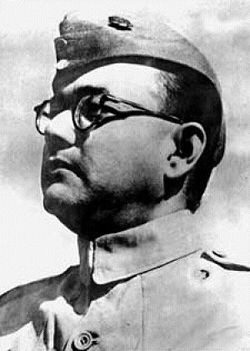
The seminar was to celebrate and remember the achievements and sacrifices of Subhas Chandra Bose, reverentially called Netaji, and his army of freedom fighters, the Azad Hind Fauj (Indian National Army) which was founded in Singapore in 1943.
The INA drew recruits for its 100,000 strong army of men and women from amongst the Indian immigrant community of Malaya, Singapore, Thailand, Indonesia, Vietnam and Burma, including ex-British Indian Army soldiers languishing in jails as Prisoners of Wars.
Netaji’s life has been no less interesting, almost a cloak and dagger story that climaxed into a controversial plain crash, some still believing that he survived the crash and lived for many long years in cognito.
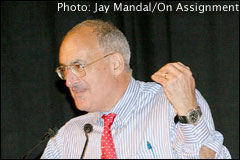
Professor Sugata Bose, Gardiner Professor of Oceanic History and Affairs at Harvard University and the great grandson of Netaji provided a scholarly analysis of Netaji’s quest for freedom during the world war.
In a short 30 minute documentary film, Prof Bose also depicted Nataji’s life as a revolutionary. Netaji was born in 1897 and revealed an independent streak right from the days of his student life. He studied philosophy at Cambridge University (Great Britain) and despite being selected for the coveted Indian Civil Services, he joins the Indian National Congress (INC) in 1921 to fight for India’s independence from British rule.
By 1939 he got disillusioned with INC and in 1941 escapes from under strict British surveillance at his house in Calcutta as a Muslim insurance salesman. He arrived in Berlin, married a German woman, and ever met Hitler to enlist his support in his fight against the British. Finally, Netaji arrived in Singapore through Tokyo and assumed the leadership of INA on 4 July 1943.
Under his leadership, the INA fought a number of bloody battles with British and American forces on Indian soil in 1944 and Burma in 1945. In his paper, The INA: Its Contribution to India’s Independence and Asia’s Resurgence, Mr Prasenjit K Basu of Khazanah Nasional demonstrated that INA’s success in turning the British Indian army against their rulers was instrumental in making Britain free India.
Netaji's family and country were coterminous, said Professor Bose.
Interestingly, Netaji had made a daring submarine to Submarine transfer with a Japanese crew near Madagascar, while travelling from Europe to Japan.
When Netaji arrived in Singapore, he was given a hero’s welcome and people sang this song in his praise:
Subhashji Subhashji Subhashji Aa Gaye
Hai Naaz Jis Pe Hind Ko Wo Naz-e Hind Aa Gaye
While addressing the public on July 4 in Cathay Theatre, he gave a call for Total Mobilisation for a Total War. All he promised to the patriots was bhook, pyaas and maut.
He gave the slogan of Delhi Chalo, which mobilised the masses. His strategy was to attack the British both from inside and outside.
One of the most revolutionary things that Netaji did was the founding of the Rani of Jhansi Regiment in 1943, a women-only regiment. Jenaki Thevan of Singpore was made its leader.
During the Bengal famine of 1943, in which about one third to half of Bengal’s population died, Netaji offered to send rice from Burma to Bengal, but the British not only suppressed the news, they never allowed it happen. Churchill said that while he would bomb all the Germans to death, he would kill the ‘vicious’ Indians by starving them to death.
Netaji proclaimed the establishment of the Arzi Hukumate Azad Hind in Singapore on 21 October 1943. Nine countries around the world recognized this government including Thailand and Ireland.
Singapore’s Indian businessmen, initially a little tight-fisted, finally showered Netaji’s govt. coffers with contributions. The Chettiars of Tamil Nadu were great contributors.
Whenever Netaji addressed the public here, his speech was translated into Hindustani and Tamil. His official flag was the tricolour with Gandhiji’s charkha with the image of a springing tiger, reminiscent of Tipu Sultan.
Netaji wanted India’s national language to be Hindustani, a mixture of Hindi and Urdu, written in the Roman script.
Interestingly, his slogan, Jai Hind, was coined by him and his friend and fellow struggler, Abid Hussain. Abid had travelled with him from Germany to Asia and had kept him company throughout. Ambassador Abid Hussain, who was also present in the seminar, is the nephew of Abid Hussain.
In December 1943, when the Japanese Govt, handed him the control of Andaman and Nicobar Islands (whom he wanted to rename Swaraj and Swatantra), he visited the Cellular Jail where many nationalists had achieved martyrdom.
In 1944, he moved his headquarters to Rangoon. Indians in Burma also helped him generously. One Abdul Habeeb Saheb donated millions for his cause.
Though the INA lost the Battle of Imphal in 1944, he said that these temporary failures will lead to ultimate success. “The roads to Delhi are many more,” he said. After losing the battle to telegram, cannons and automatic rifles (INA soldiers had muskets), they retreated on foot from Burma to Thailand under constant enemy firing—they walked on foot for 23 days!
On 8 July 1945, the foundation stone for the INA Memorial was laid in Singapore, with the motto of the martyr: Unity, Faith, and Sacrifice. The British with cannonfire later blew the memorial away in the last war.
Netaji’s patriotism and revolutionary ideals not only informed the history of India, it also had profound impact on the society and politics of the entire South East Asia. Professor A Mani and Professor P Ramasamy argued in their paper that INA affected the psyche of Indian immigrants of South East Asia who were mostly living and working in appalling conditions as plantation workers. Through INA, their minds were awakened and revitalized, which later affected the trade unions, politics and community organizations of South East Asia.
Three INA veterans, namely, Mrs Rasammah Bhupalan and Mrs Janaki Nahappan of Malaysia and Mr Ajit Kumar Guhatakurta of Singapore, who had fought under the command of Netaji, recounted their experiences of being a part of INA.
Subhas Bose’s saga lives on even after his reported death on August 18, 1945 but these veterans have kept the flame of Bose legacy alive.
Though he was said to have died in an air accident at Taipei on Formosa Island, The Hindustan Times'public probe concluded that “on present evidence it would seem improbable that Bose died on August 18, 1945, from burns he was said to have received in the air accident at Taihoku airport.”
Whatever the truth, Netaji’s legacy of freedom will always inspire the deep bonds that exist between Singapore and India.
(The Webcast of this ISEAS seminar will be available on this page from August 21, 2006)